
I have been building a lot with AI lately, and one thing has become very obvious:
the minimum viable developer machine has changed.
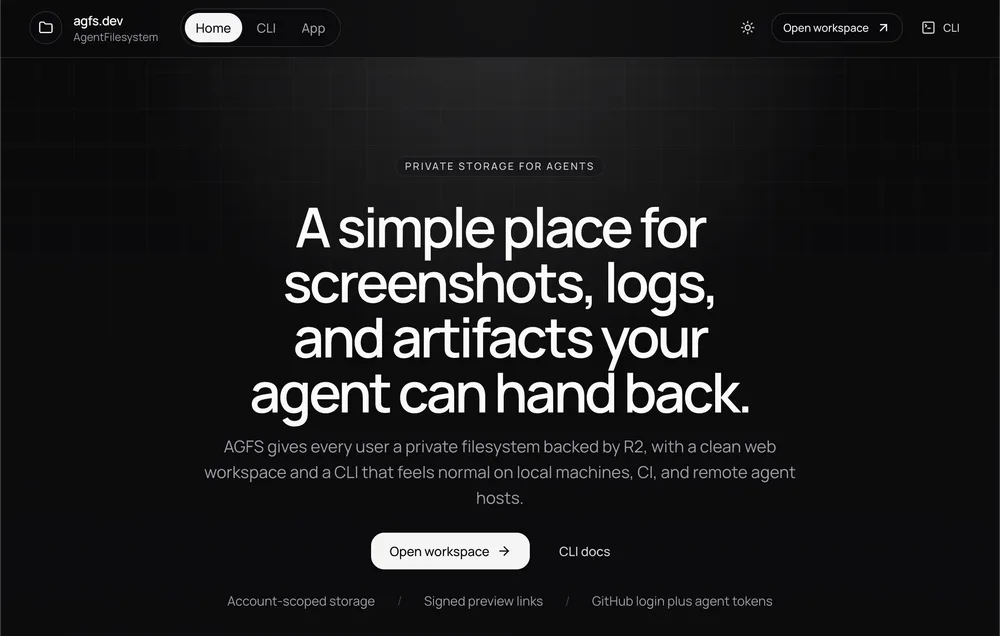
That hit me again while working on AGFS.dev from my wife’s MacBook Neo.
Not a MacBook Pro. Not some maxed-out workstation. The citrus one.
Also: not an April Fools joke.

Image source: Apple Newsroom, March 4, 2026. Original press image from “Say hello to MacBook Neo”.
On paper, this does not look like the machine you pick for software work.
Apple positions MacBook Neo as a cheap, colorful, first-Mac laptop. The official pitch is basically: durable, light, A18 Pro, 13-inch display, up to 16 hours battery, and friendly pricing. That sounds more like “school laptop” than “build and ship internet products.”
And honestly, if you handed this machine to someone five years ago and asked them to do serious dev work, I would have been skeptical too.
Why it works better than you’d think
The old model of programming assumed your laptop needed to do everything locally:
- run the heavy IDE
- run Docker
- run databases
- run browsers with too many tabs
- run builds
- run the whole mental load too
That is still true sometimes.
But not always.
When you use a good AI agent well, a lot of the work moves up a level.
The bottleneck stops being raw local horsepower and becomes:
- can you open the repo
- can you inspect files fast
- can you run a terminal
- can you review diffs
- can you keep a clean loop with the agent
For that kind of work, the MacBook Neo is fine. More than fine, really.
It is quiet. Light. Battery-friendly. Easy to keep near you. Easy to hand someone who is new to this stuff without making the machine itself feel intimidating.
That matters more than people admit.
What I was actually doing on it
This was not “hello world.”
I was working on AGFS.dev, which is my tool for making remote agent files easy to upload, browse, and share.
That means the job was a mix of:
- reading and editing app code
- checking CLI behavior
- reviewing flows
- verifying uploads and links
- moving between product decisions and implementation quickly
A lot of that work maps extremely well to an AI agent.
Instead of treating the laptop like the entire factory, I was treating it like a control surface:
- the AI agent handled a big chunk of repo navigation and implementation
- remote environments handled work that did not need to live on the laptop
- the laptop stayed focused on review, prompting, terminal commands, testing, and steering
That is a very different workload than “compile everything locally while six background services fight for RAM.”
And for that workload, the Neo held up.
Why AI agents change the equation
The most interesting part here is not the MacBook Neo itself.
It is what tools like this do to the definition of a “good enough” dev machine.
If the app can understand a codebase, search it, edit it, explain it, and help carry the boring parts, then the human spends more time on:
- product judgment
- architecture calls
- reviewing output
- testing the important path
- deciding what should happen next
That does not make hardware irrelevant.
If you do heavy local mobile builds, large Docker stacks, ML work, video, or multiple emulators, you should still buy more machine.
But if your workflow is more:
- web apps
- scripts
- API work
- content
- product building
- AI-assisted coding
then the floor is lower than it used to be.
Much lower.
Why I think it is a solid first developer machine
This is the part I keep coming back to.
The MacBook Neo does not look like a developer laptop. That is exactly why it is interesting.
For a first machine, especially for someone learning with AI tools, it has a lot going for it:
- approachable price
- long battery life
- simple setup
- good keyboard and trackpad
- enough performance for modern web work
- less pressure to become a hardware expert before becoming a builder
That last point is big.
A lot of people do not get blocked by lack of talent. They get blocked by ceremony. Too much setup. Too many choices. Too much mythology around what counts as a “real” machine.
If someone can open a laptop, install the tools they need, start an AI agent session, and ship something useful, that counts.
AGFS.dev is a good example of the shift.
I was building a product about remote agents and file handoff from a machine that many people would dismiss too quickly. And it worked because the center of gravity has moved. More of the leverage now comes from tooling, systems, and taste than from raw local compute alone.
Where the limits still are
I do not want to oversell it.
This is not my argument that everyone should replace a serious workstation with a MacBook Neo.
The limitations are obvious:
- fewer ports
- less headroom
- worse fit for big local infra
- not the machine I would choose for the heaviest workloads
But “not ideal for everything” is very different from “not good enough to start.”
That gap is where a lot of new builders can win.
Final thought
My wife’s MacBook Neo feels like a joke pick for development right up until you actually use it with the right workflow.
Then it starts to feel like a preview.
If AI-native coding tools keep improving, a lot more software is going to get built from modest laptops, weird little machines, and computers that old assumptions would have disqualified immediately.
And honestly, I like that.
It means more people can start.