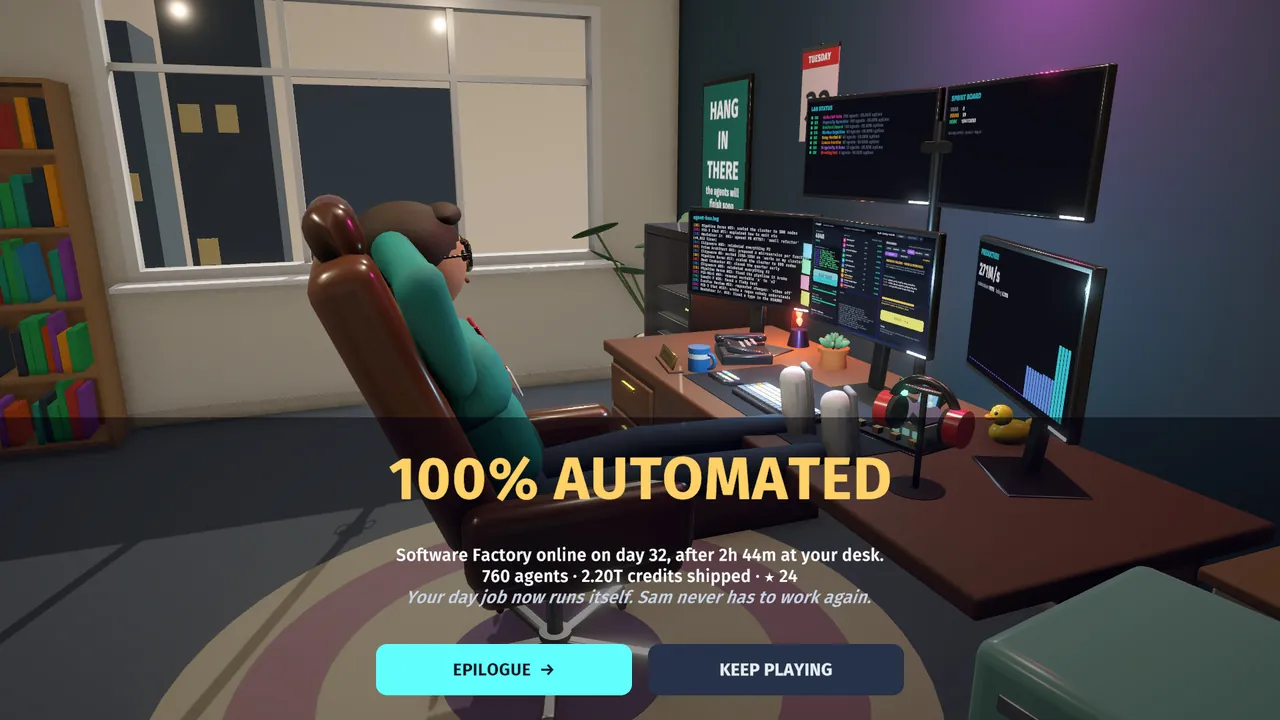
Synergex Corp’s CEO has read an article about AI. The memo goes out on Monday morning: Synergex is now AI-First, and every engineer is expected to deliver 10x output by the end of the quarter.
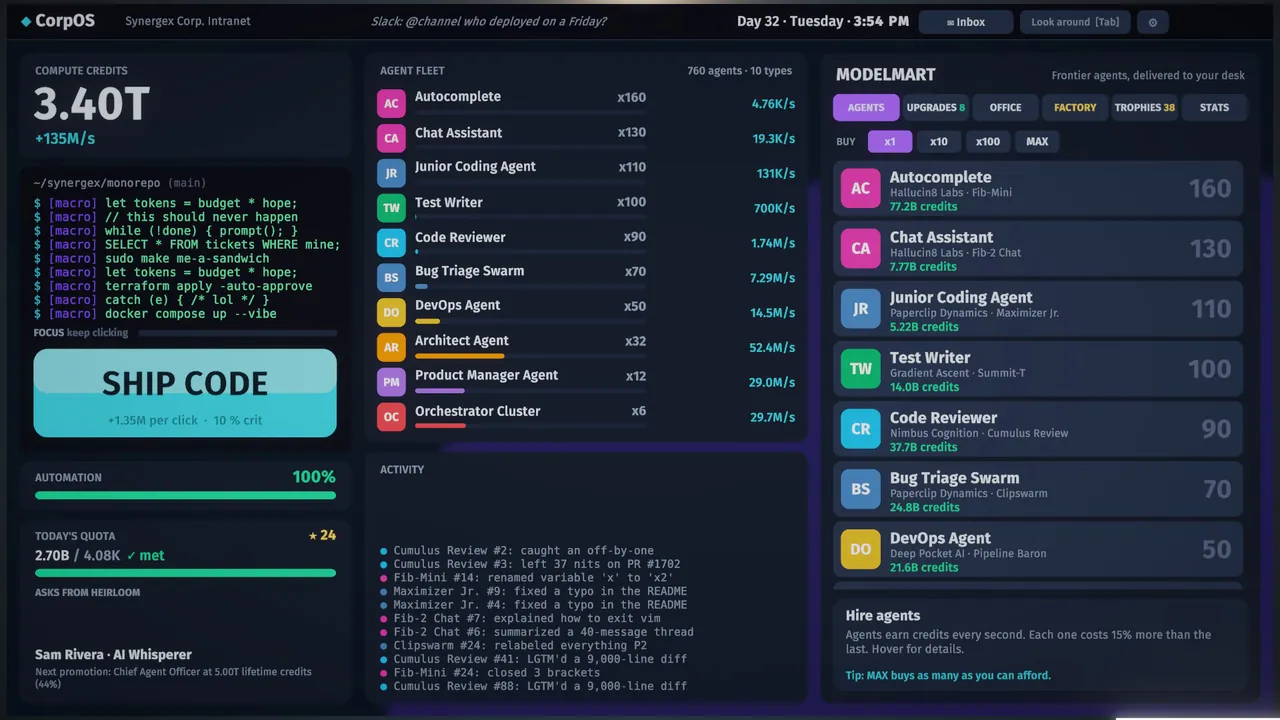
You are Sam, a developer at a very ordinary desk. Every morning you clock in, sit down, and log in to CorpOS, a whole game running on the monitor in front of you. Ship code by hand, earn compute credits, and hire AI agents from a marketplace of entirely fictional frontier labs: Hallucin8 Labs (“Move fast and make things up”), Paperclip Dynamics, Deep Pocket AI, OmniSapient, and more. Agents write the code, then review the code, and eventually manage the agents that write the code.
The goal is the Software Factory: every agent wired into one pipeline, 100% automated, and Sam leaning back with their feet on the desk.
A game inside a game
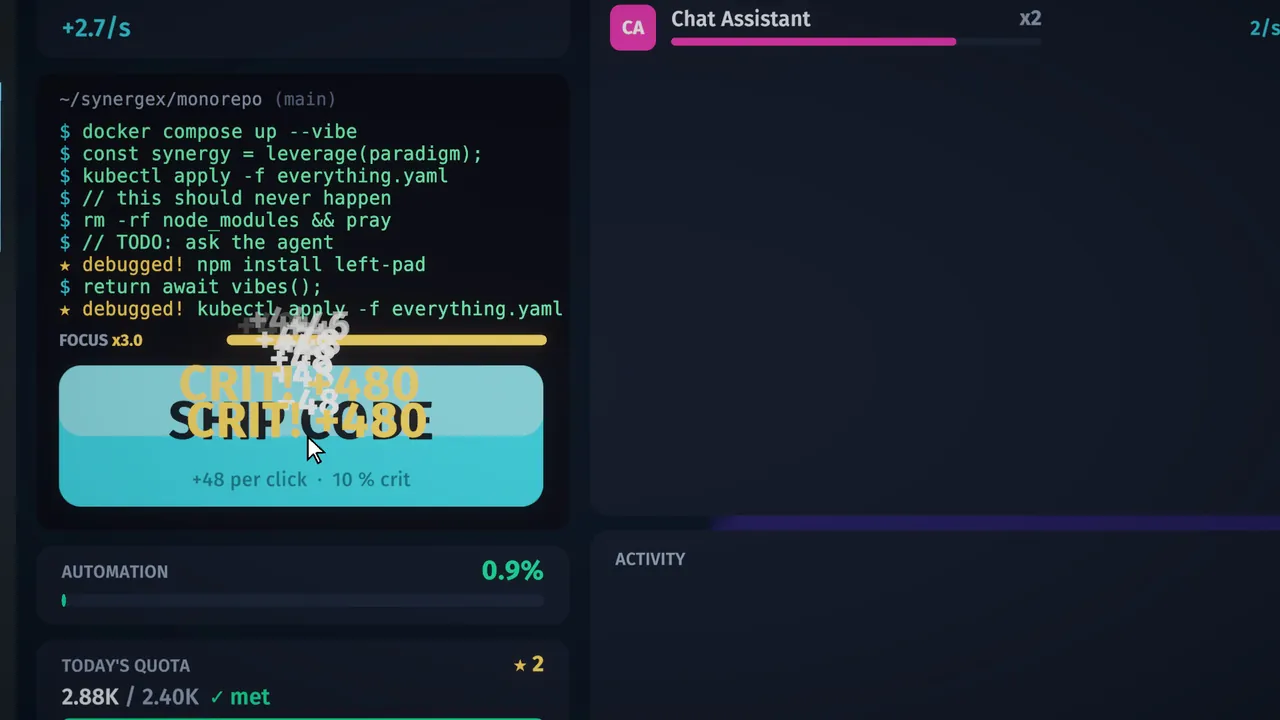
Click SHIP CODE to earn credits, and spend them in the ModelMart on agents that earn every second and on upgrades that multiply them. Steady clicking builds Focus, worth up to ×3, which drains as soon as you stop. CorpOS is a full 2D interface living on the monitor’s screen mesh in the 3D office; it stays live from the office view, and the camera dollies in until it fills the screen.
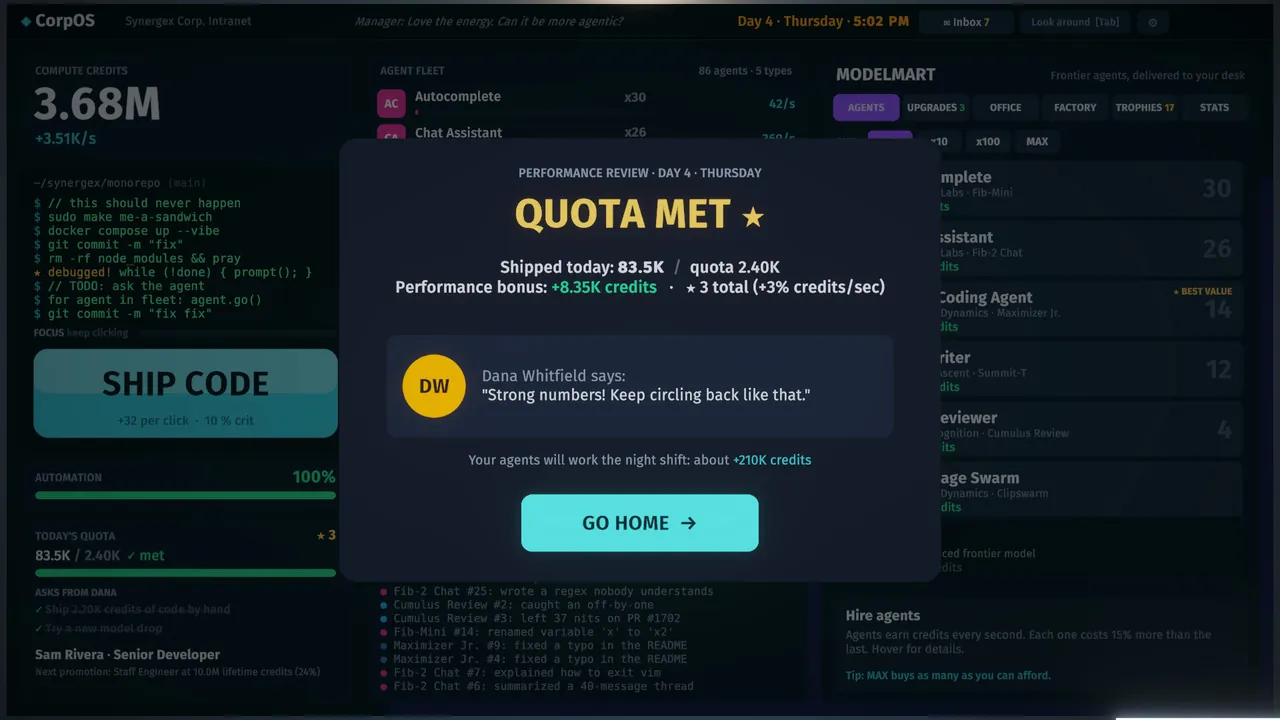
A work day runs from 9 to 5, five real minutes by default. At 5 PM a performance review compares the day against your quota, and your agents work the night shift.
Your desk is the upgrade screen
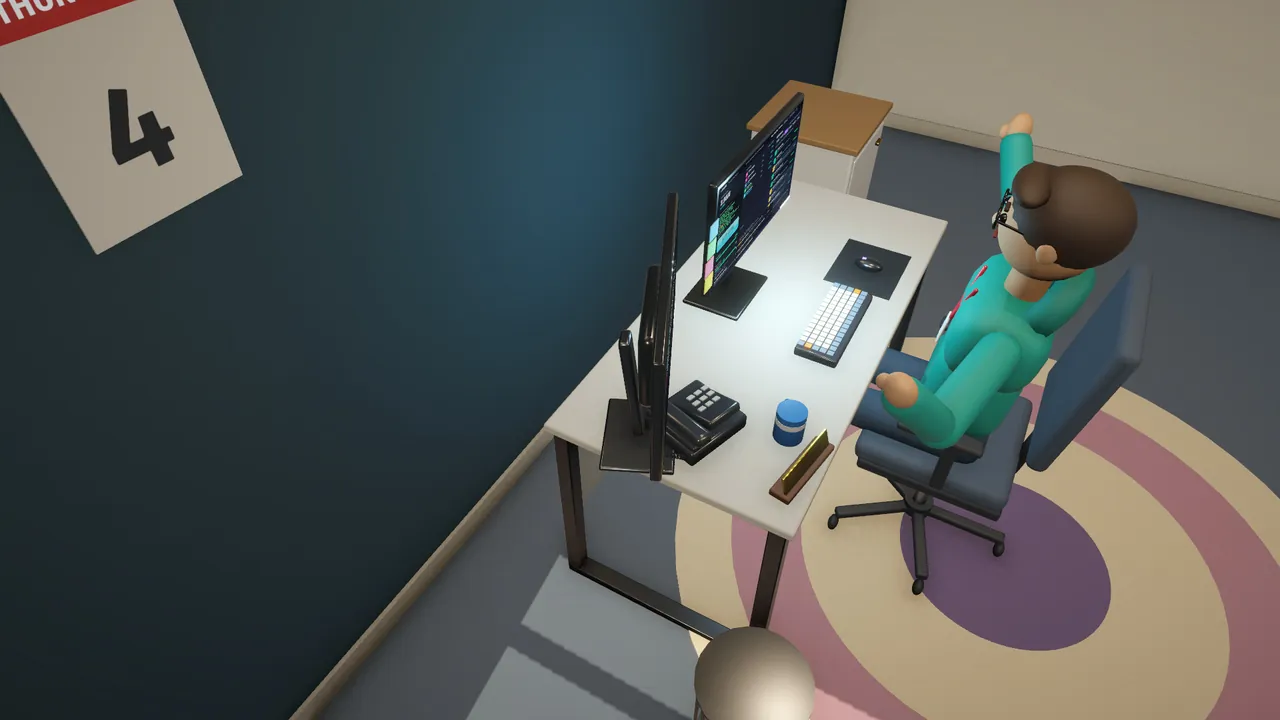
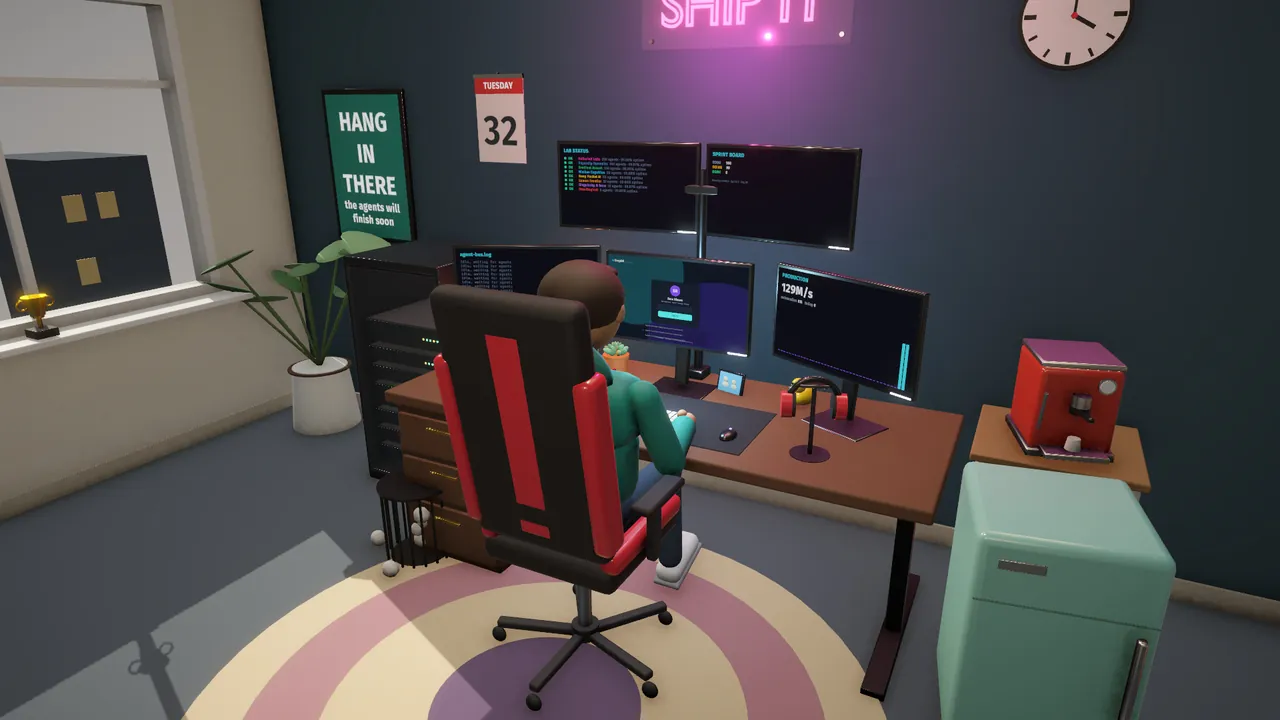
Eighteen office gadgets, from a company mug and a rubber duck to a lava lamp, an espresso machine, a homelab server rack, a monitor wall, and a “SHIP IT” neon sign, pop into the 3D office with a camera showcase, and each has a real bonus. Promotions change the room: the cubicle walls disappear, and a rug, bookshelf, sofa, and trophies arrive.
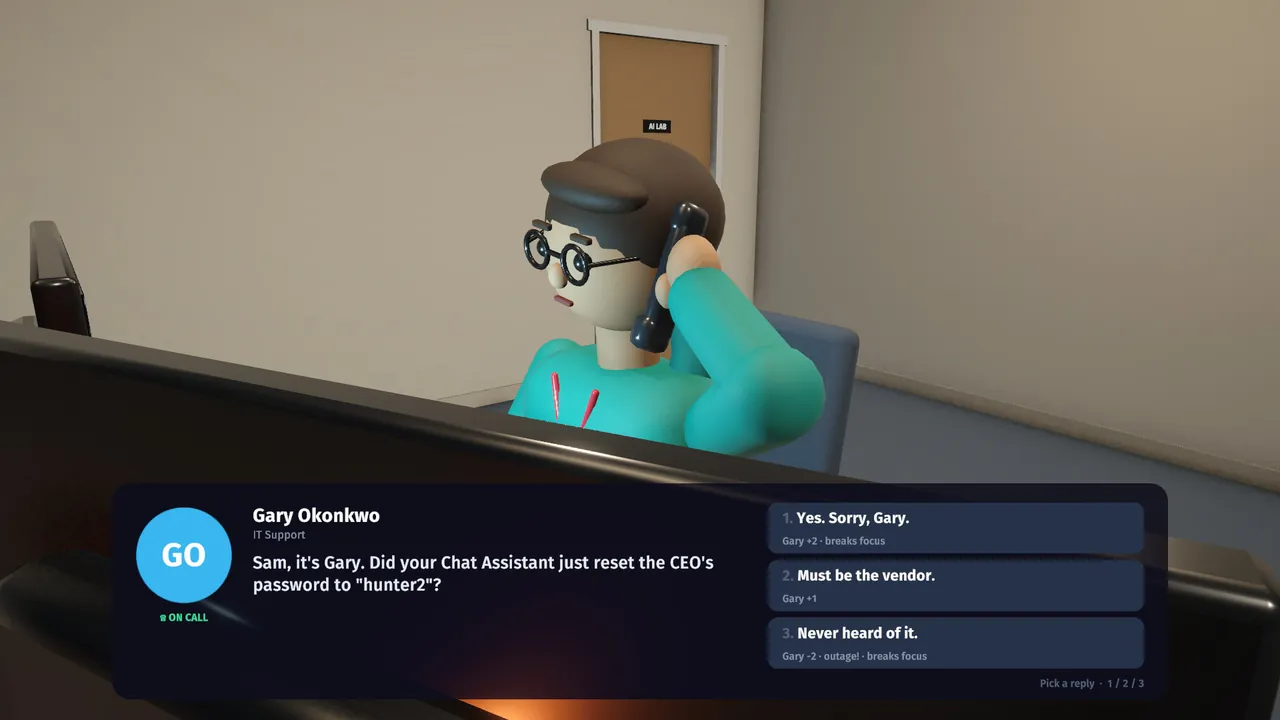
The desk phone rings. It might be your manager asking for a demo, Gary from IT asking why your Chat Assistant reset the CEO’s password to “hunter2”, a recruiter, your mom, or eventually your own agents escalating tickets to you. Every reply has consequences. Model drops are the game’s golden cookie: catch the card before it vanishes for a burst of production. API outages halve production until you click the banner enough times to fail over.
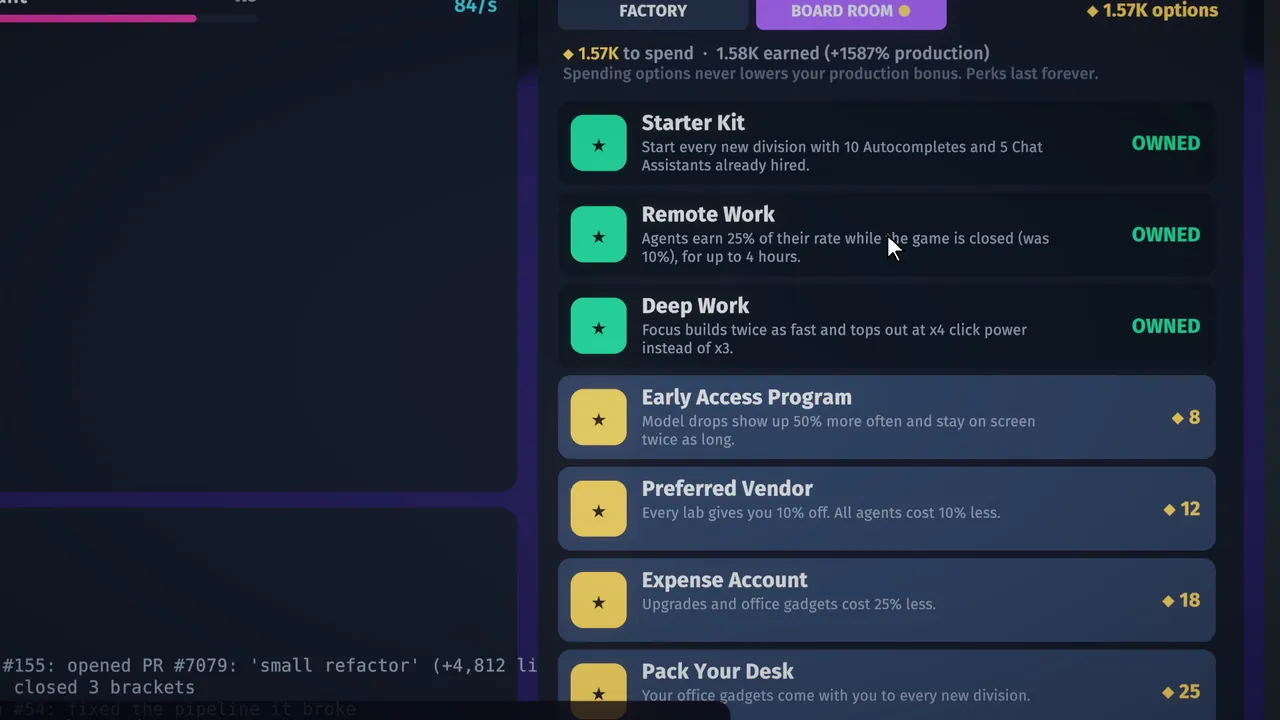
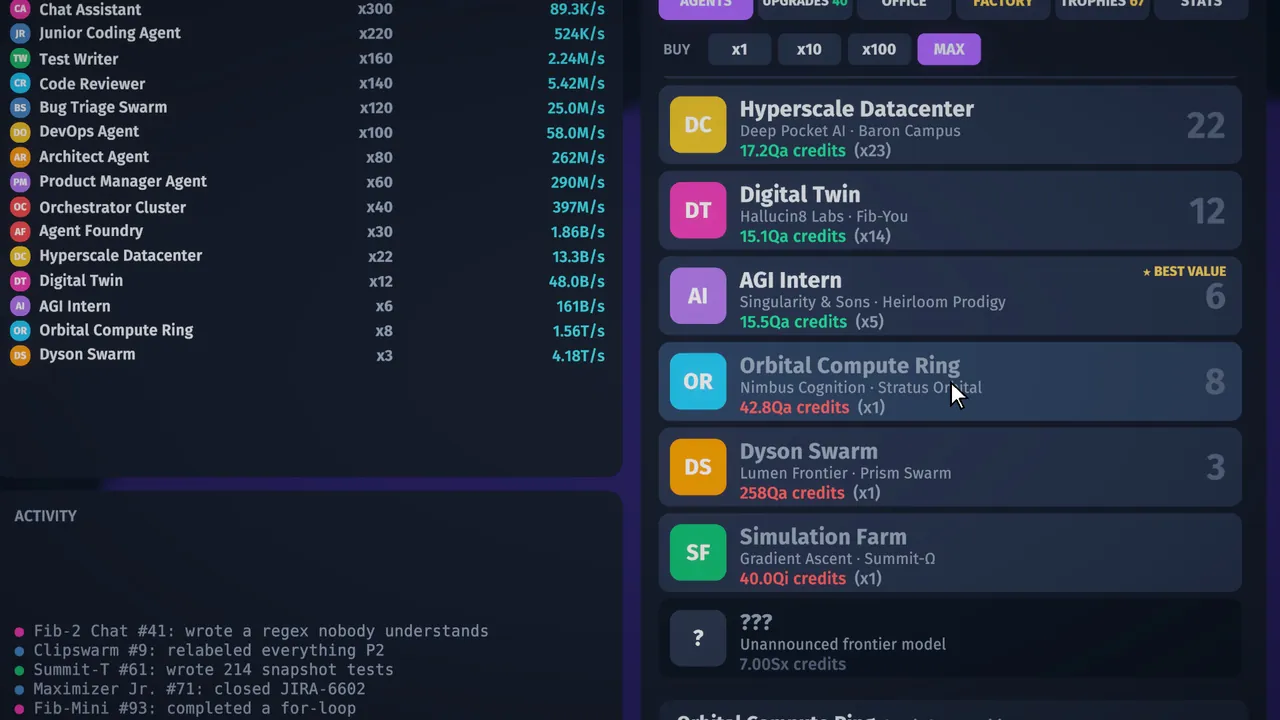
The story is told in 26 emails across six chapters, from The Mandate to The Factory, and the epilogue changes depending on how you treated people. Building the Factory ends the story but not the game. Frontier agents follow, including a Digital Twin of Sam, an AGI Intern, a Dyson Swarm, and The Singularity. Reorgs roll the Factory out to new divisions for Stock Options, there’s a Board Room of permanent perks, there are 512 trophies, and the numbers climb all the way to a centillion.
More screenshots
What it’s built with
The economy is a plain C# model with no Unity dependencies, covered by 96 EditMode tests. A BalanceSimulator plays the game greedily, and the test suite fails if the bot reaches the first Factory in under 1.5 or over 5 hours. A person should take about three. All money math saturates at the largest double-precision number, so huge values can’t turn into NaN or Infinity in a save.
Unity 6 and URP render the office. The UI, including CorpOS, the store, the inbox, and calls, is built at runtime with uGUI and TextMesh Pro. Because an idle game spends a lot of time in the background, performance got real attention: nested canvases so a ticking number only rebuilds its own batch, pooled floating numbers, prewarmed font atlases, and a 15 fps cap when the window is unfocused. A late-game office runs at about 1.7 ms of main-thread CPU at 60 fps while clicking fifteen times a second.
How it was made
Everything is generated from code. Blender scripts build all 46 models from primitives, and material names carry meaning: EMIT_* glows, GLASS_* is transparent, Screen marks a monitor. An import pipeline turns them into URP materials. Sam is a rigged employee made of rigid parts, with ten animations, such as typing, sipping, facepalming, and feet-up, baked on one timeline and split into clips on import. Typing speed follows your click rate.
The game ships with zero audio files. Key clicks, chimes, the phone ring, the office hum, and a 76 BPM lo-fi loop are synthesized on a worker thread when the game starts. The trailer is played by a scripted director that clicks real UI through Input System events while the game records itself. It was developed with Claude Code.
Play it
Version 0.1.0 is complete and playable from the first click to the endless game. Download it from GitHub releases. The macOS build is experimental and unsigned. It’s mouse and keyboard only. Every lab, AI model, company, and person in the game is fictional.
Browse the source on GitHub. GitHub records the repository’s creation on October 4, 2026.