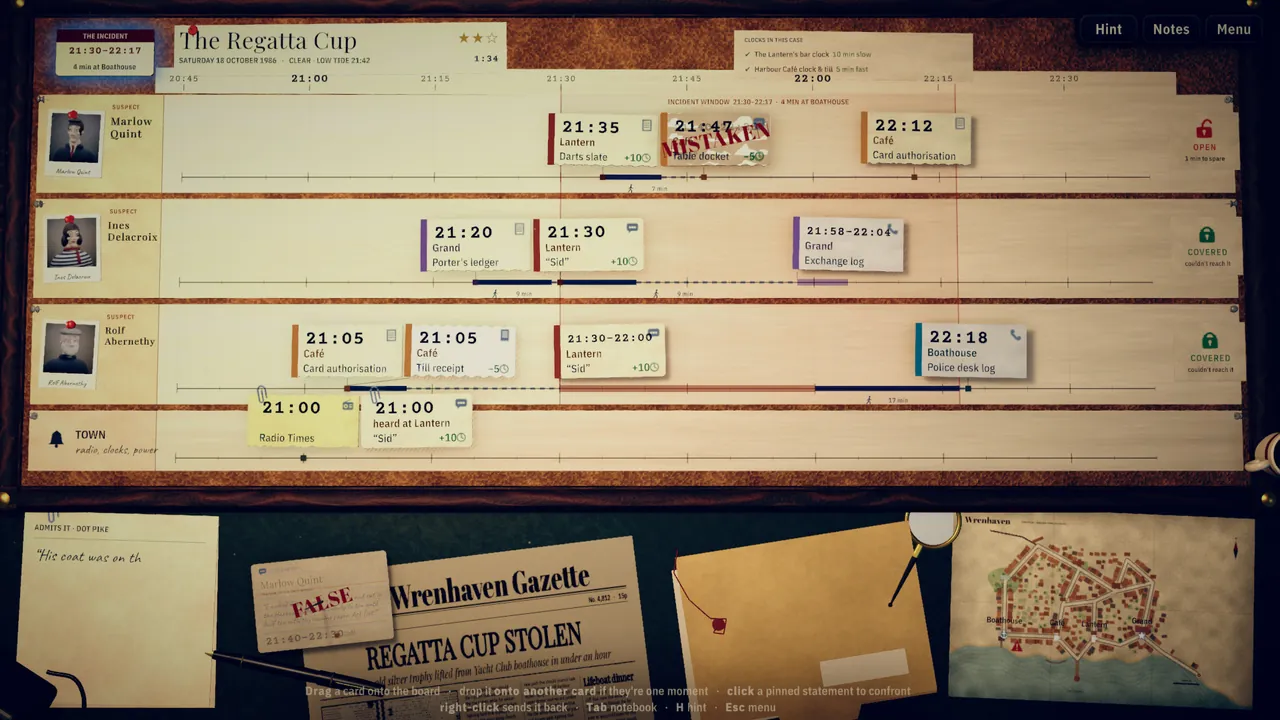
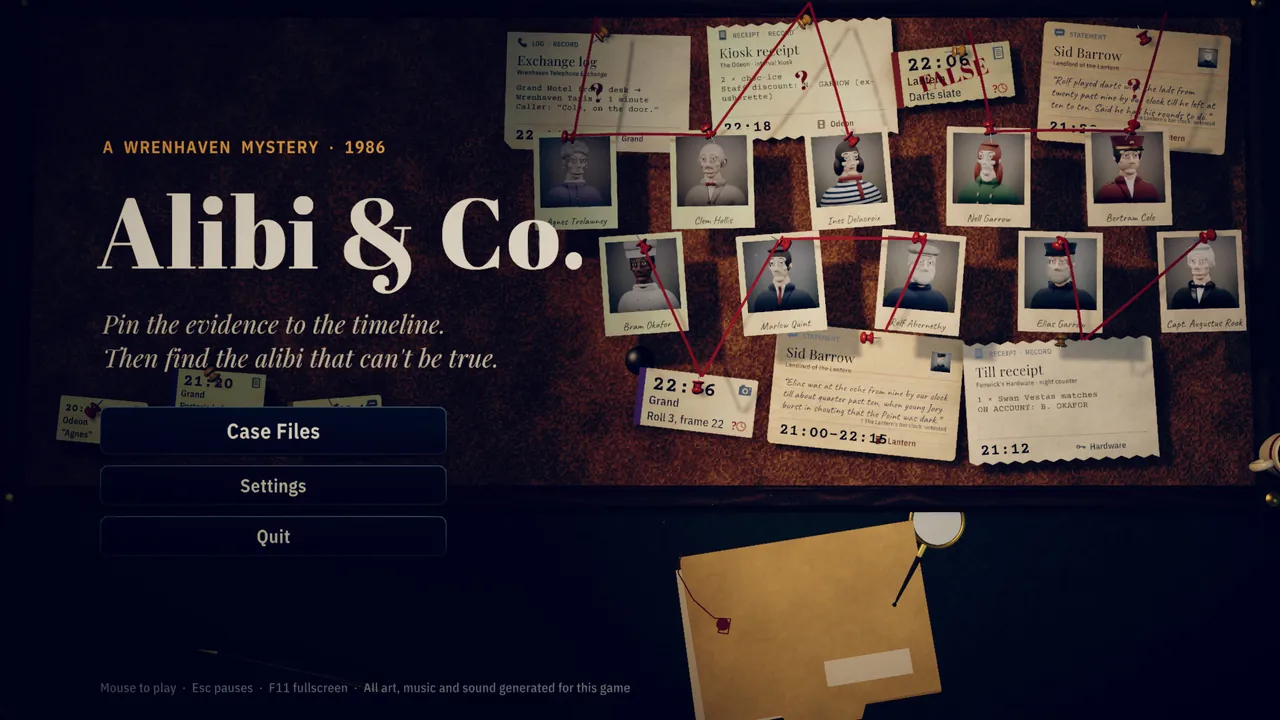
Wrenhaven is a harbour town in autumn 1986. You’re the ”& Co.” at retired Detective Inspector Connie Alibi’s two-desk agency. There are three small crimes, three nights, and one cork board.
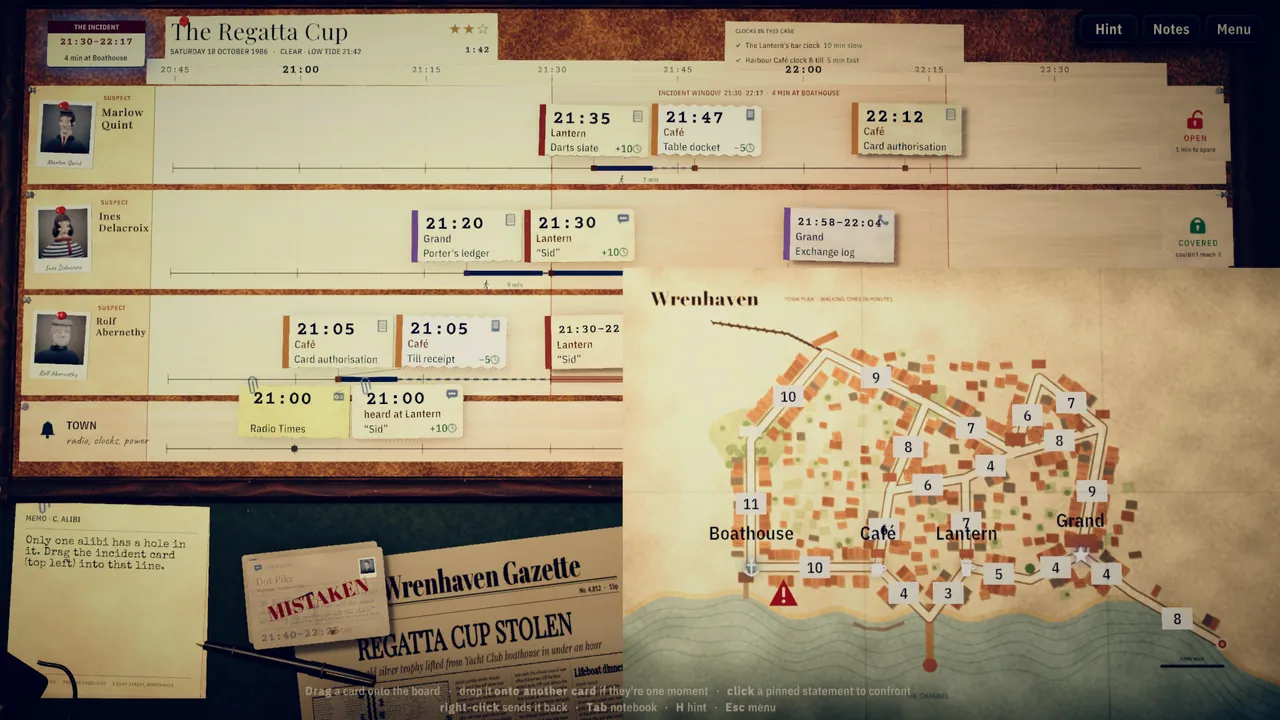
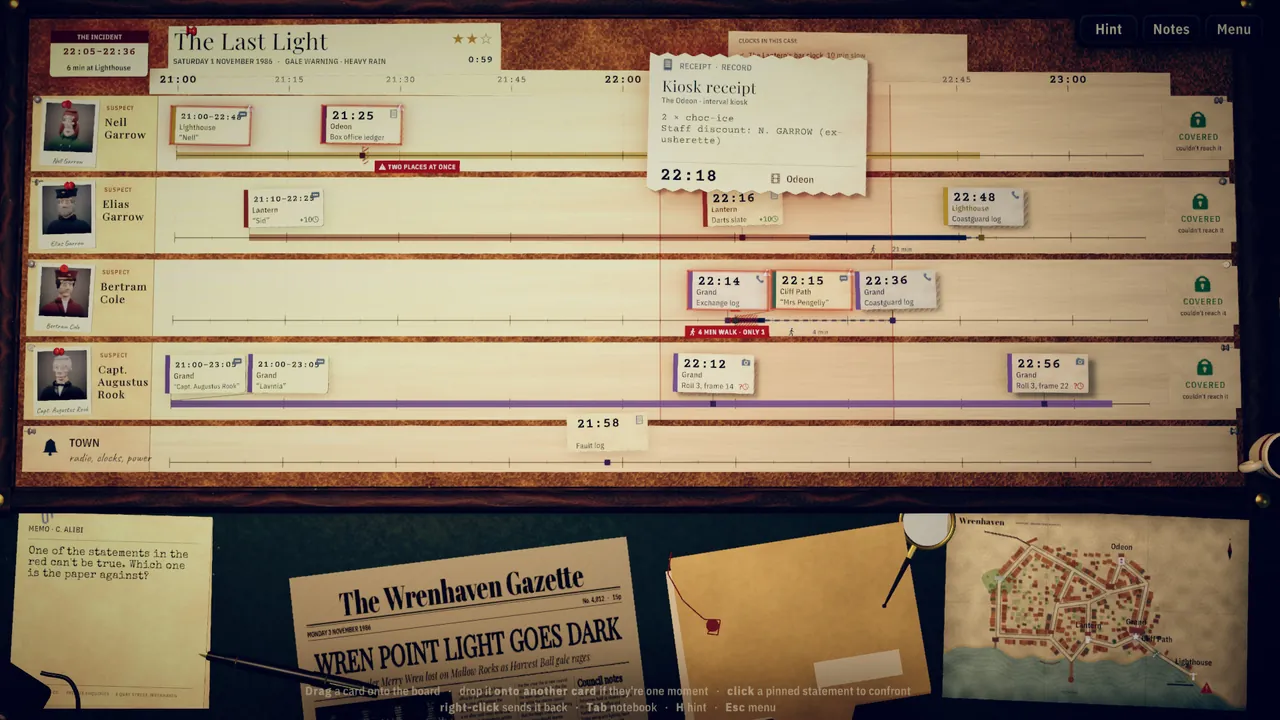
Every receipt, phone log, ticket stub, press photo, and witness statement says that someone was somewhere at a certain time. Pin them onto each suspect’s line, and the board measures the walk between them on a real town map. Blue ribbons mean there was time. A red ribbon means a story has just become physically impossible, and somebody, or some clock, is wrong.
The board does the arithmetic. You do the doubting.
Paper beats people
Records are never false, but their clocks can be wrong. Statements can be false, and a lie isn’t proof of guilt. That distinction drives the whole game.
Confront a statement that’s part of a contradiction. If it’s false, the witness admits it and the card is stamped FALSE or MISTAKEN. If it’s true, they stand firm and you lose a badge. Link two cards that describe the same moment seen on two different clocks. If one clock is trusted, like the telephone exchange, the BBC, the church bells, or the Electricity Board, the other clock’s error is found, and every card it stamped slides to its true time. One receipt moving five minutes can sink an alibi.
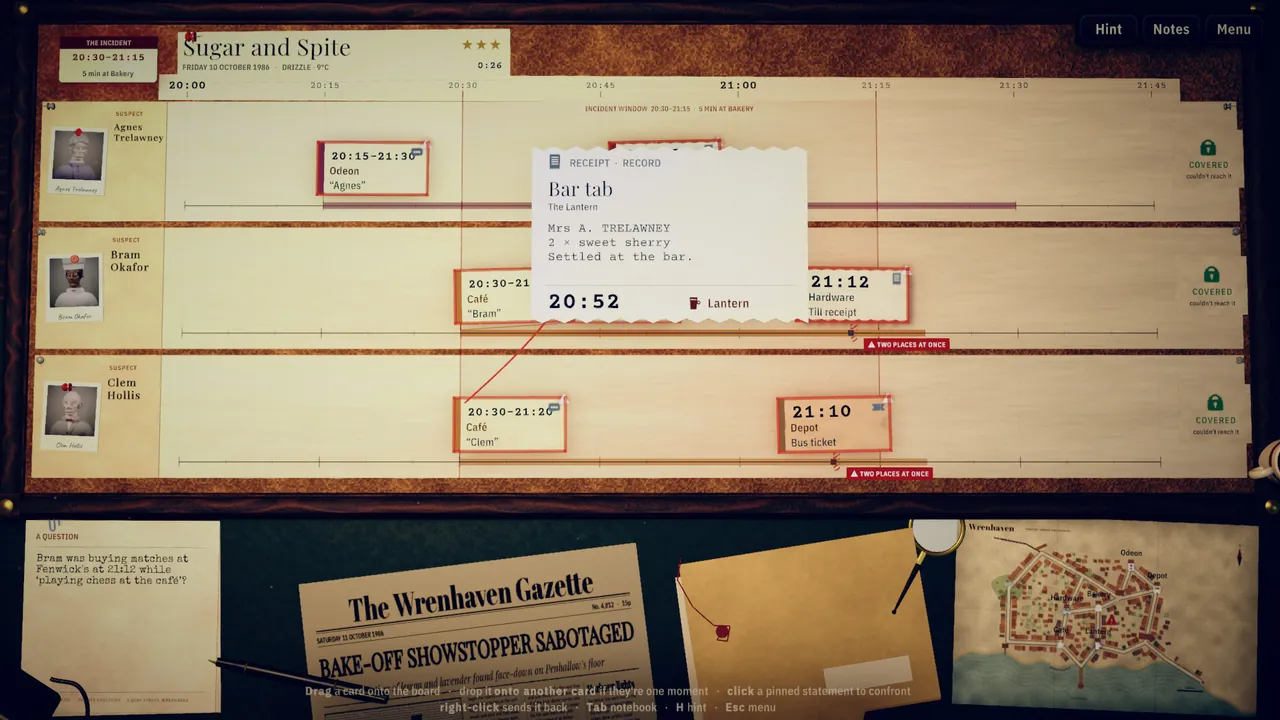
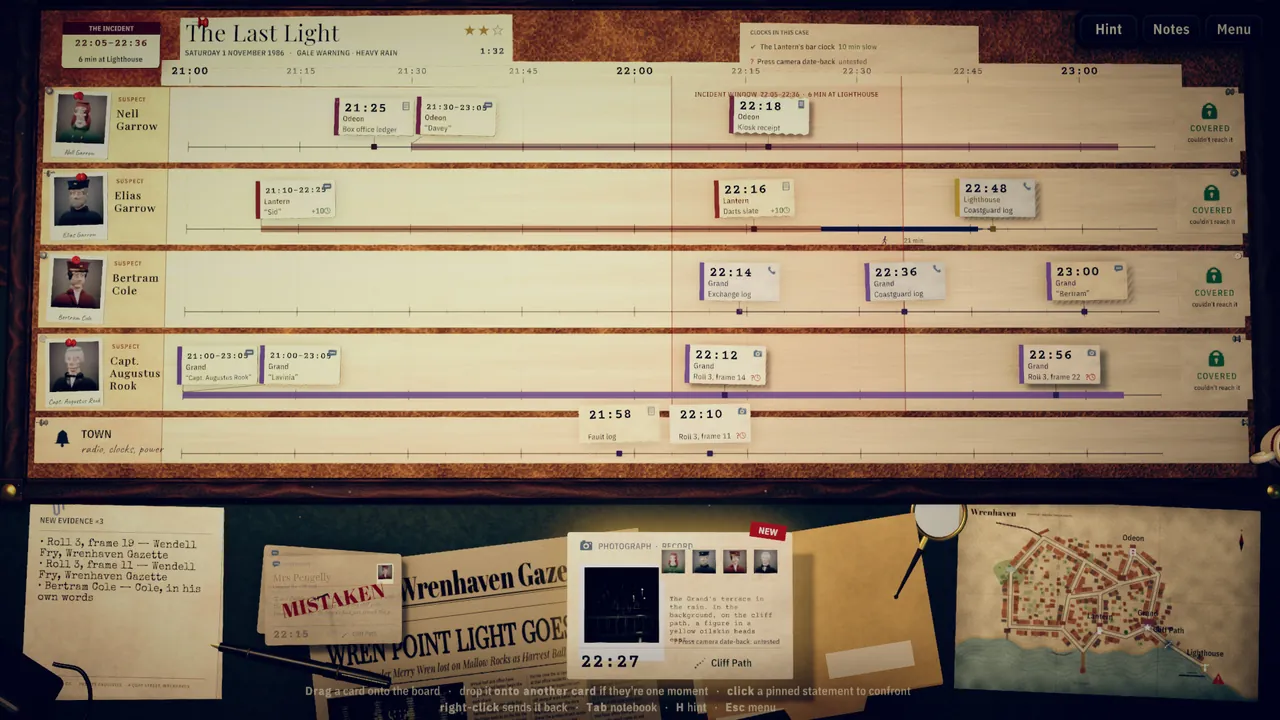
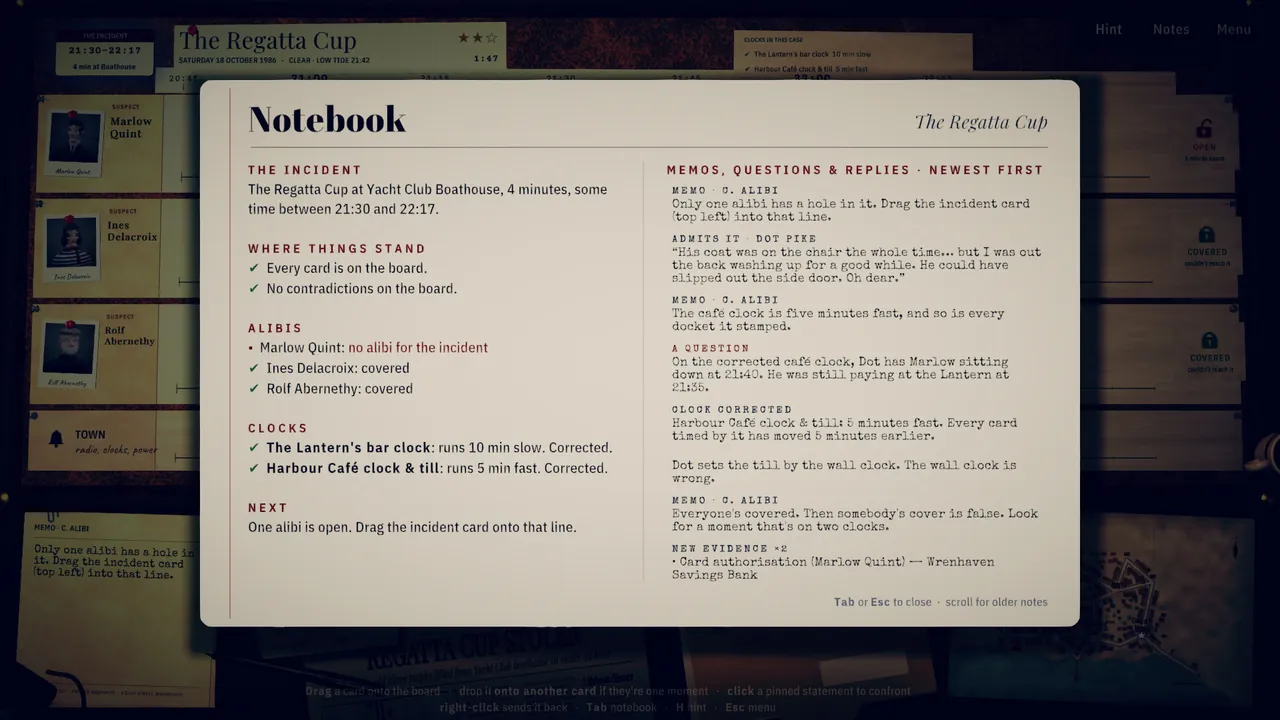
Unknown-person cards, such as a cash receipt or a figure in a photo, show candidate faces that are crossed out as the records rule people out. Each suspect shows a lock: COVERED if they couldn’t have reached the scene for long enough, OPEN if they could. The incident can only be pinned when nothing is contradicting and it fits exactly one line, so a wrong accusation is impossible by construction. Then a brass pawn walks the culprit’s route across the map while the night replays, and the Wrenhaven Gazette prints the front page.
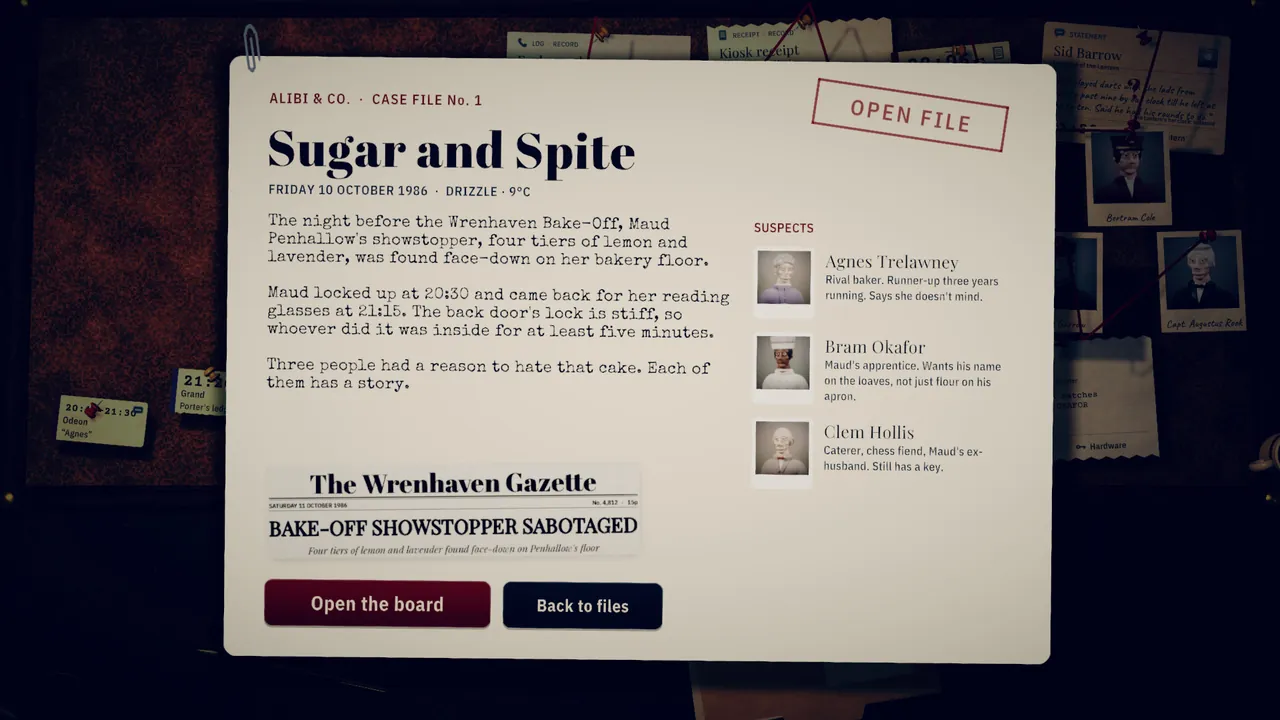
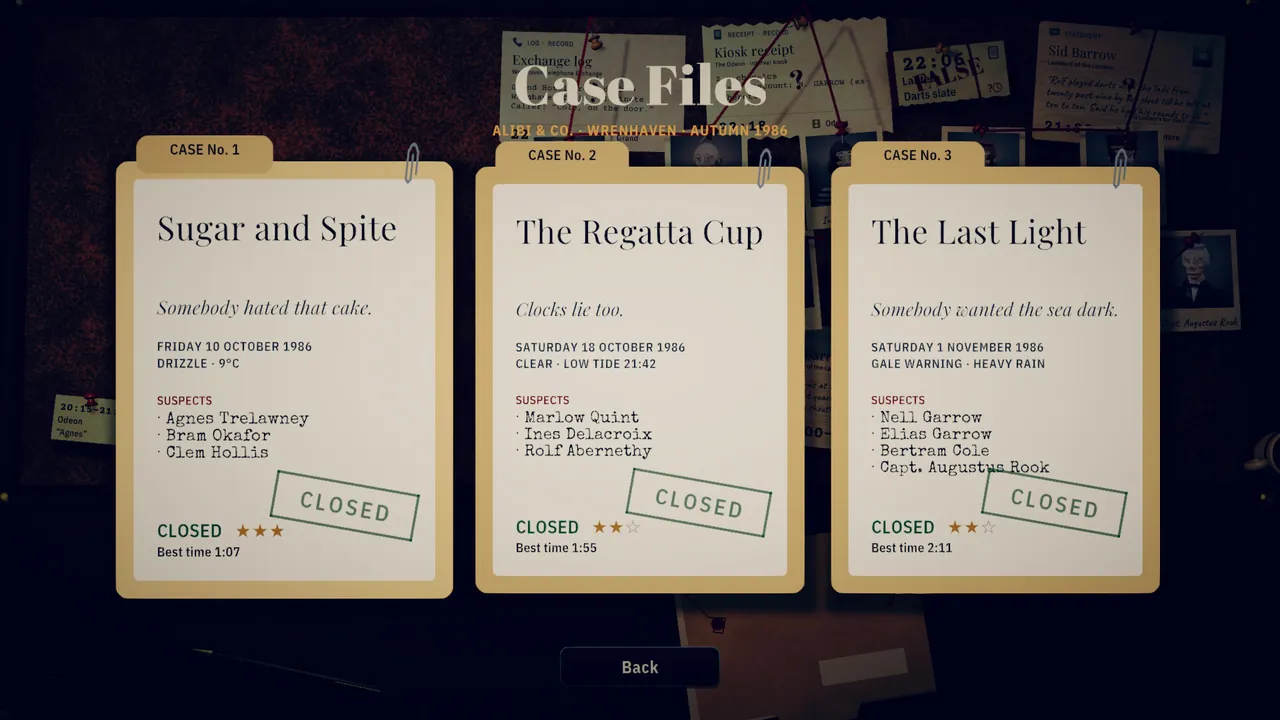
There are three handcrafted cases of roughly five, ten, and fifteen minutes. Each teaches one new idea: pinning and contradictions, then clocks and links, then unknown persons and a camera’s date-back clock.
More screenshots
What it’s built with
Everything that decides the game, including the board, case data, town map, and solver, is plain C# in Assets/Scripts/Logic/ with no Unity dependency. Unity 6 renders it, and a .NET console app compiles the same files to check it, so the game and the validator can’t disagree.
Clocks are data. Every card names the clock that timed it, and each clock has a hidden offset. A link between two cards calibrates the untrusted clock, and the board recomputes every card’s true time and walking feasibility in one pass, using all-pairs shortest paths over the town’s street graph.
CaseValidator searches every reachable board state using only legal moves. It checks that each case has exactly one consistent solution, that the solved state can be reached from every state, that every designed contradiction can be discovered, that unknown cards only ever resolve to the right person, and that no state allows a wrong accusation. The build runs it before it packages anything.
How it was made
Alibi & Co. started with a thorough design and technical plan, and its pillars set the tone: the board does the arithmetic and you do the doubting, paper beats people, everything is a physical object on a lamp-lit desk, every case is provably airtight, and it’s cozy noir rather than grimdark. Its commit history spans about nine and a half hours on October 4, 2026.
The pipeline is procedural from end to end. Blender scripts model and render the props, portraits, press photos, and the town map; the suspects are built from fused ellipsoids, voxel-remeshed and smoothed into one surface. The map is generated from the same town.json the game uses, so its streets match the walking times exactly. Python and NumPy synthesize the score, using Karplus-Strong bass, FM Rhodes, vibraphone, and brushes, along with the foley. Pillow ages the photos and typesets each case’s newspaper.
The recorder pipes raw frames to FFmpeg while the game clock steps exactly one frame at a time, and an audio director logs what every voice plays on each frame so the soundtrack can be rebuilt offline.
Play it
Version 0.1.0 is a complete, small game: three cases from start to finish. Download it from GitHub releases. It’s played with a mouse and keyboard.
Browse the source on GitHub. GitHub records the repository’s creation on October 4, 2026.