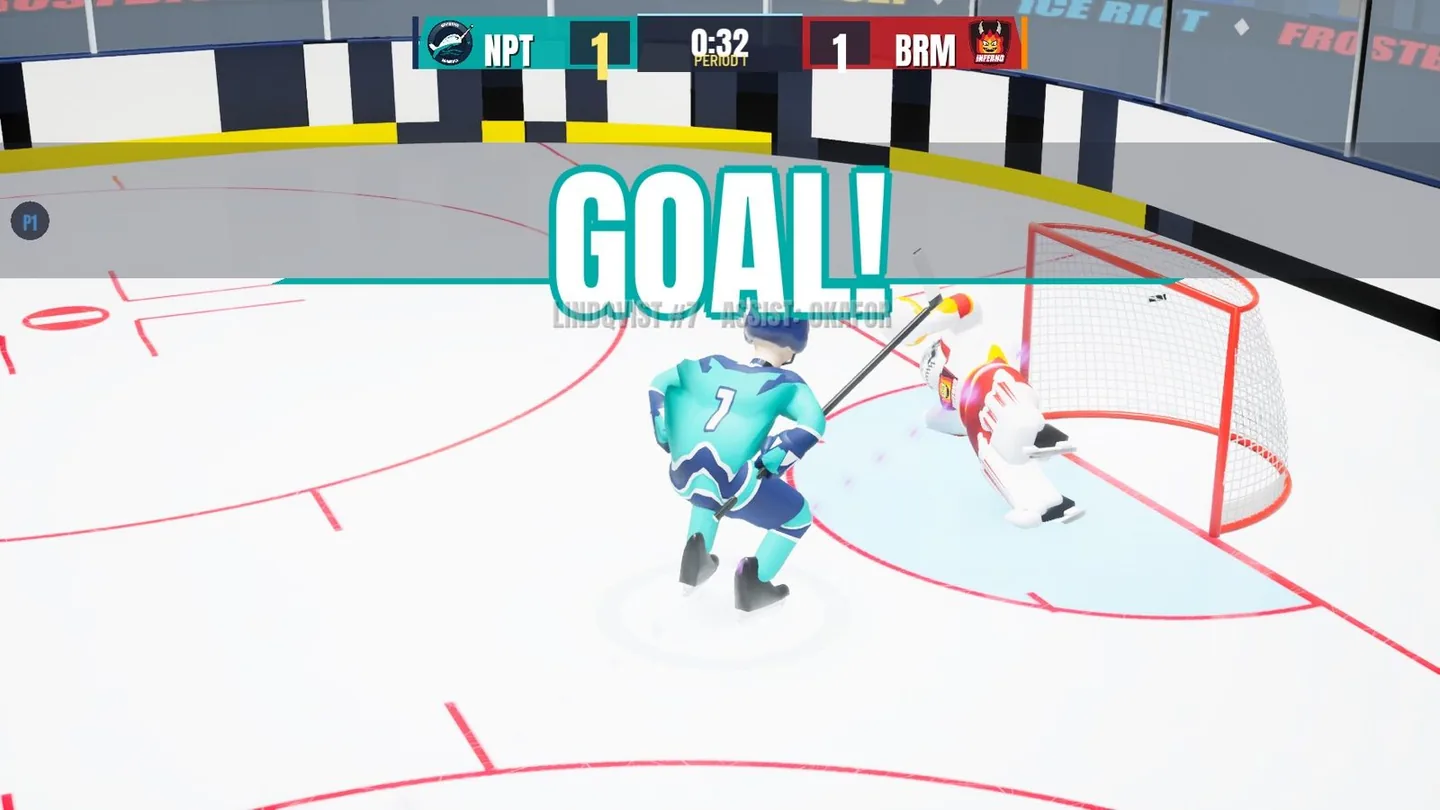
ICE RIOT is an original, over-the-top arcade hockey game for up to eight players, inspired by the 3D arcade hockey cabinets of the mid-90s and their Nintendo 64 ports: fast 3-on-3, turbo, flaming power shots, bone-rattling power checks, fights, hat tricks and instant replays. Its design notes were researched from the period’s instruction manual and reviews, and the README says every team, player, logo, sponsor and announcer line is fictional. The code is under the MIT License, and the fonts, Anton and Barlow Semi Condensed, are under the SIL Open Font License.
The game is C++ on Unreal Engine 5.9, with no Blueprints, and Python scripts in Blender 5.3 generate every model, texture, rig and animation. Every sound is synthesized, and the announcer is macOS’s speech synthesizer run through a simulated arena PA. The browser version isn’t a port: it’s Unreal’s own WebAssembly and WebGPU export of the same game, and there’s a Mac app too.
Three on three, rules optional
Each side has three skaters and a computer goalie, or four skaters with the Team size option, and the game switches to 4-on-4 when either side has more than three humans. Games are three periods of 1, 1.5, 2, 2.5, 3 or 5 minutes, two by default, and a tie goes to sudden-death overtime, in periods three quarters as long, but at least a minute, until someone scores.
Arcade rules, the default, have no icing, no offside and no penalties, so hooking and tripping are fair game. Pro rules call icing when a team at even strength or better sends the puck from its own half across the far goal line, wide of the net, and offside when an attacker is more than 45 centimeters over the blue line as the puck crosses it. Icing brings a face-off in the offending team’s own end, and offside one in the neutral zone. Under Pro rules, a trip is penalized 75 percent of the time and a hook 22 percent, and the offender sits for an eighth of the period length, but at least 12 seconds, which makes it 15 seconds with two-minute periods. A power-play goal ends the penalty early.
Turbo, fire and hits
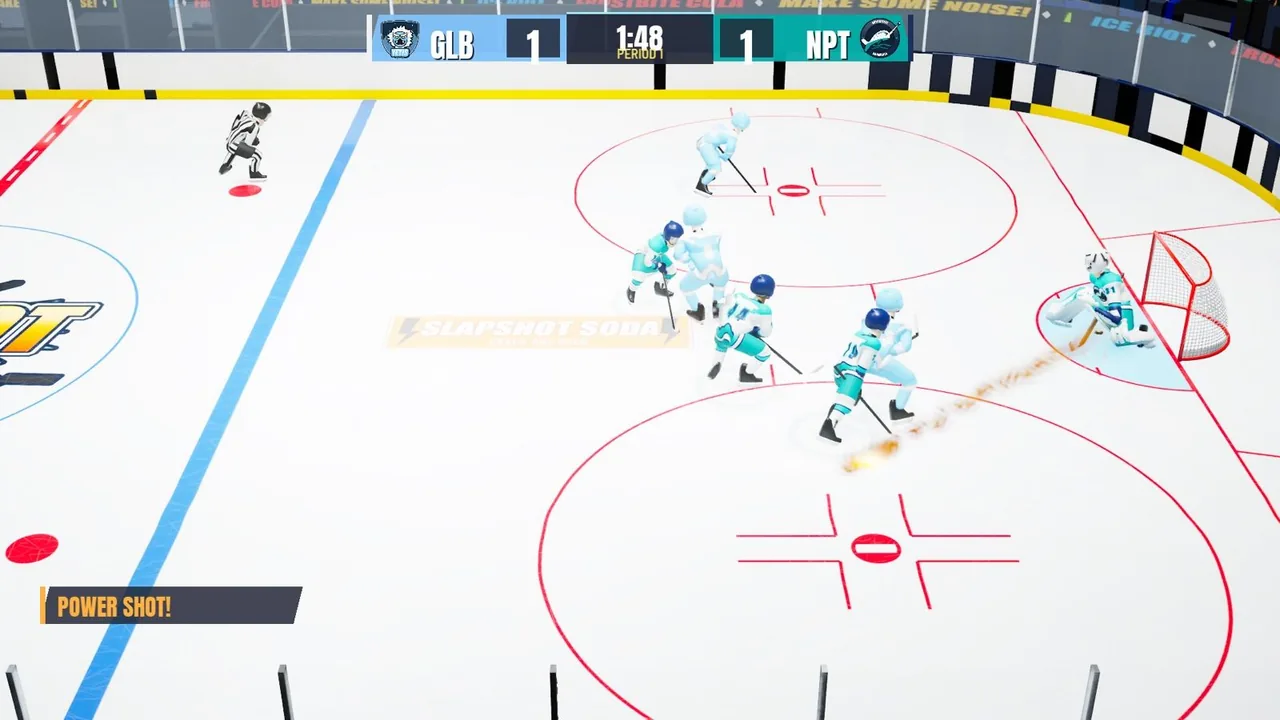
Holding Turbo raises a skater’s top speed by 42 percent and acceleration by 60 percent. A full meter lasts 2.5 seconds, starts refilling 0.55 seconds after you let go and takes about four seconds to fill again, and for a human player the colored ring under the skater doubles as the meter. Tap Shoot for a wrist shot, or hold it to charge a slap shot. Shoot with Turbo is a power shot: it needs and uses 45 percent of the meter, the puck catches fire and leaves a streak, and if it goes in, the net bursts into flames and the goalie is blown back into it. Shoot and Pass together send a give-and-go pass, which the teammate one-times the moment it arrives if they’re in a scoring spot, and pressing Shoot as a pass comes to you winds up your own one-timer. With the puck, Switch spins into a deke and Hook leaves a drop pass. When a computer teammate has the puck, Pass calls for it and Shoot tells them to shoot.
On defense, Shoot checks and Pass pokes at the puck. With Turbo, Shoot becomes a power check for 30 percent of the meter, Pass a diving poke for 20 and Hook a trip for 15. A power check launches the victim, sends their helmet and stick flying, shakes the screen and rattles the glass, and the game’s 3D ambulance drives the length of the rink along the far boards.
Fights, hat tricks and power saves
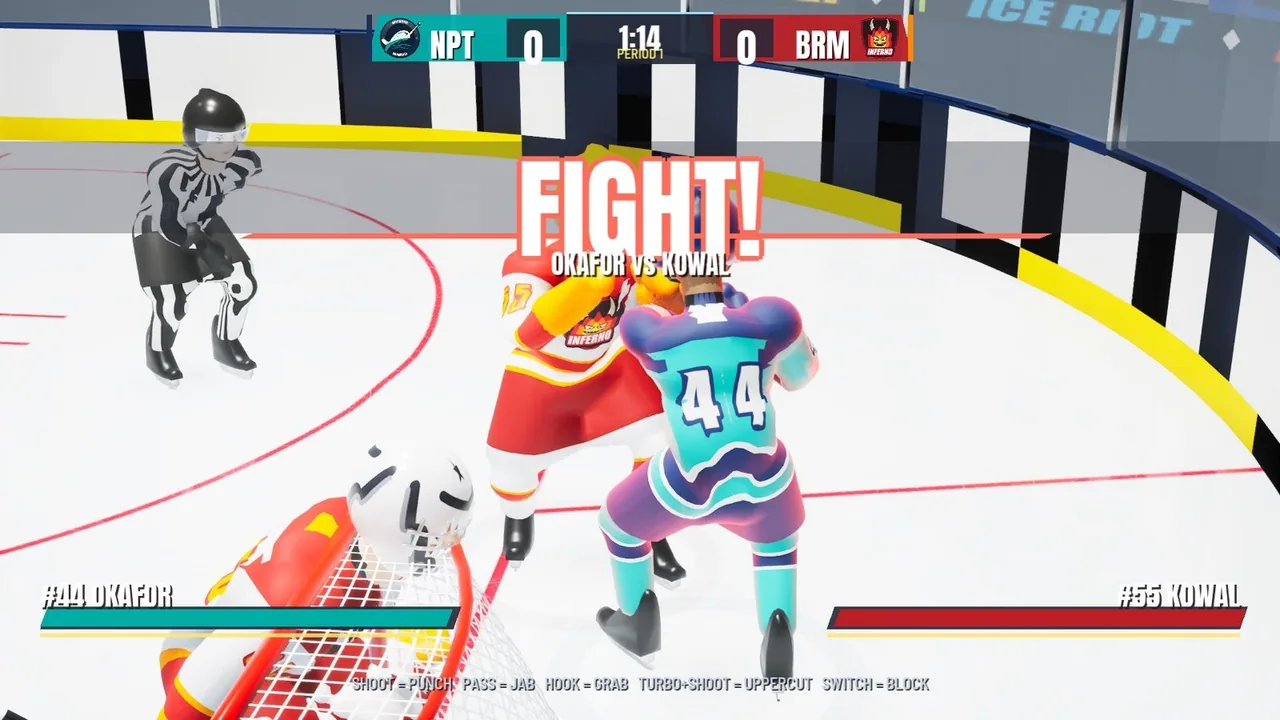
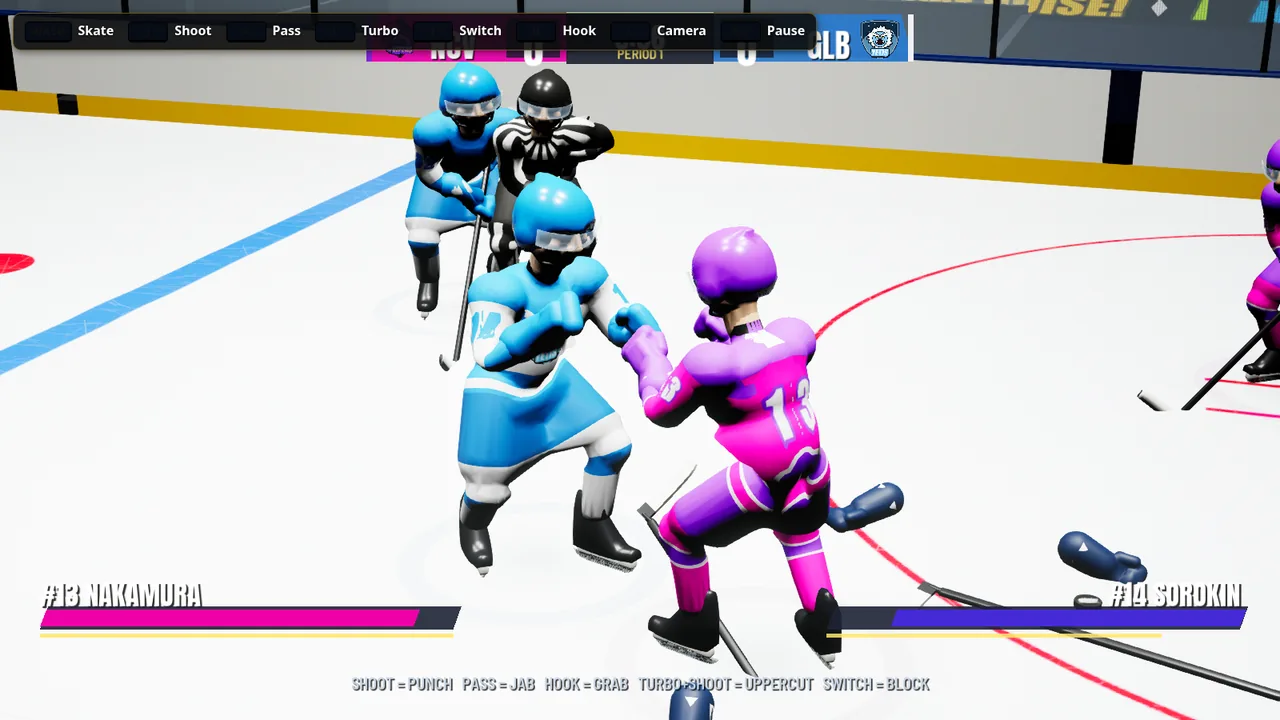
Every check adds to the victim’s anger meter, a power check most of all, and players with higher fight ratings anger faster, while hooks, steals and hard bumps add a little. When a player with a full meter is checked, there’s a 60 percent chance the two drop the gloves, though never within 40 seconds of the last fight and never with a goalie. In a fight, Shoot punches, Pass jabs, Hook grabs and stuns for a moment, Turbo with Shoot throws an uppercut, and Switch blocks, which takes most of the sting out of everything but a grab. The first skater knocked out loses and heads to the dressing room, and the next skater from the team’s roster of six takes their place. The winner gets 15 seconds of RAGE, free power shots, and their whole team gets a full turbo meter. If neither goes down in 22 seconds, the linesmen break it up, and fights can be turned off.
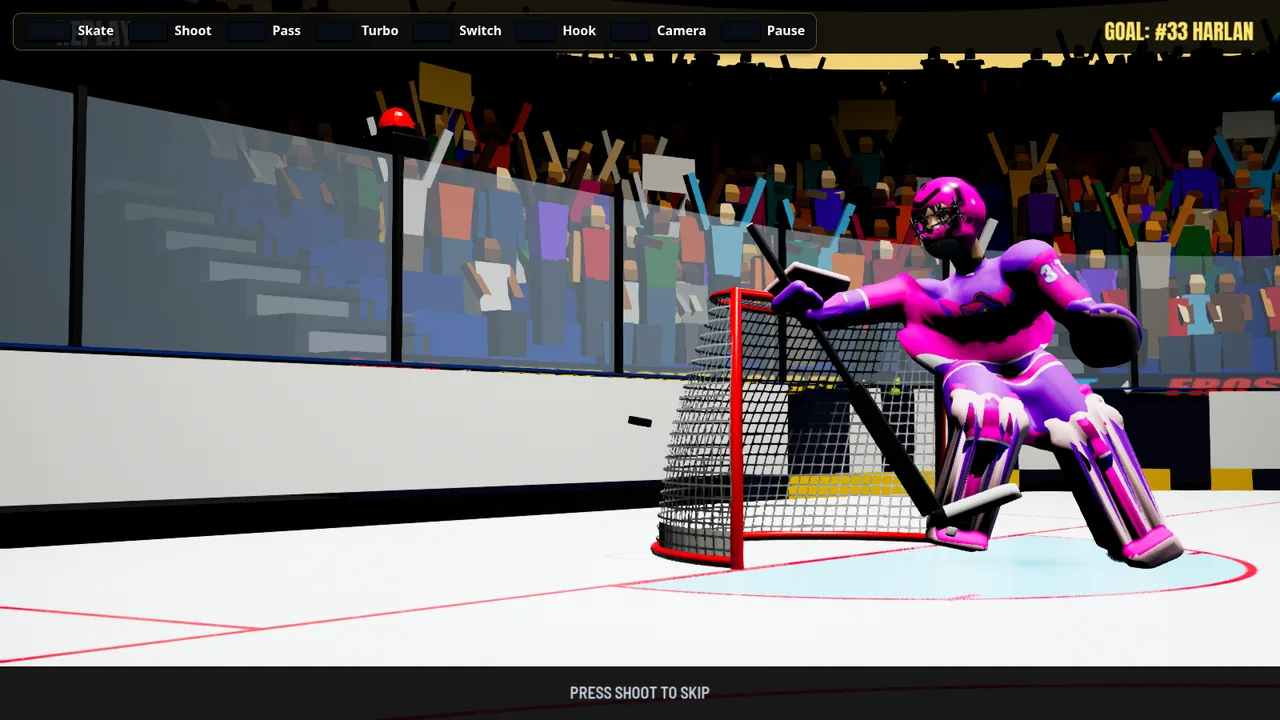
A player’s third goal of the game is a hat trick: hats rain onto the ice, and the scorer goes BLAZING, with a fire trail, 5 percent more speed, and shots that fly 10 percent faster, more accurately and on fire. The scorer of a team’s third goal in a row goes BLAZING too. Each time the other team answers with a goal, there’s an even chance the fire goes out. Goalies have their own streak: every save charges a goalie’s glow, by 13 percent or by 30 for a power shot, and the charge fades by 2 percent a second. At full charge, the goalie glows and stops the next shot on target 98 percent of the time, which the game calls a BRICK WALL!
How a save is decided
The moment a shot leaves the stick, the game works out whether it’s on target, and if it is, rolls whether the goalie stops it, so the save is decided before the puck gets there, unless a deflection, the post or the boards change its path. A goalie rated 6 starts at 88 percent, and every rating point is worth 3 more or less. Distance adds up to 25 points for long shots or takes off up to 15 for close ones, and a fast shot takes off up to 12.5. A one-timer costs the goalie 16 points and a power shot 10, while a wrist shot gives the goalie 2. A rebound within 1.2 seconds, while the goalie is still making the first save, takes off 15, a deke or a combo 6, a goalie out of position up to 30, the top corner 5, and a goalie who’s down 40. Difficulty helps the goalies against human shooters and hurts them against the computer as it rises, catch-up helps a trailing team, and the result always ends up between 12 and 94 percent, or 98 for a glowing goalie.

IRGameplay.cpp, made the moment the shot is released.Up to eight players
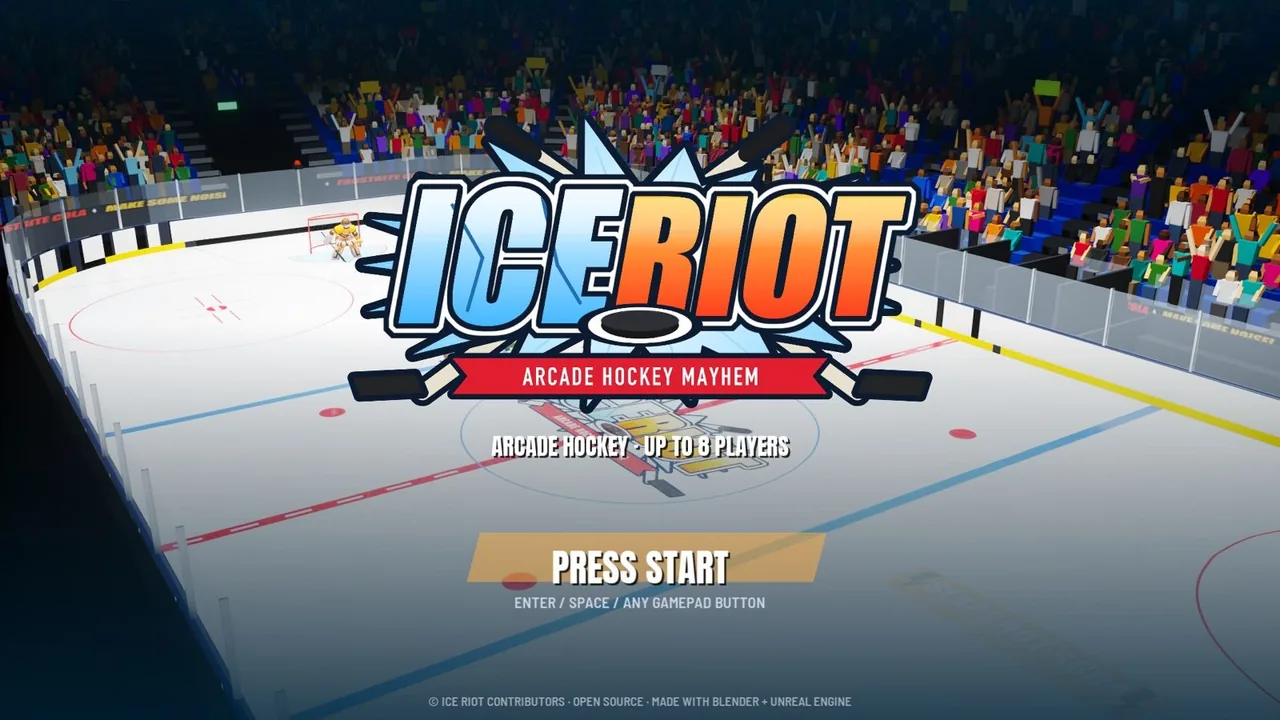
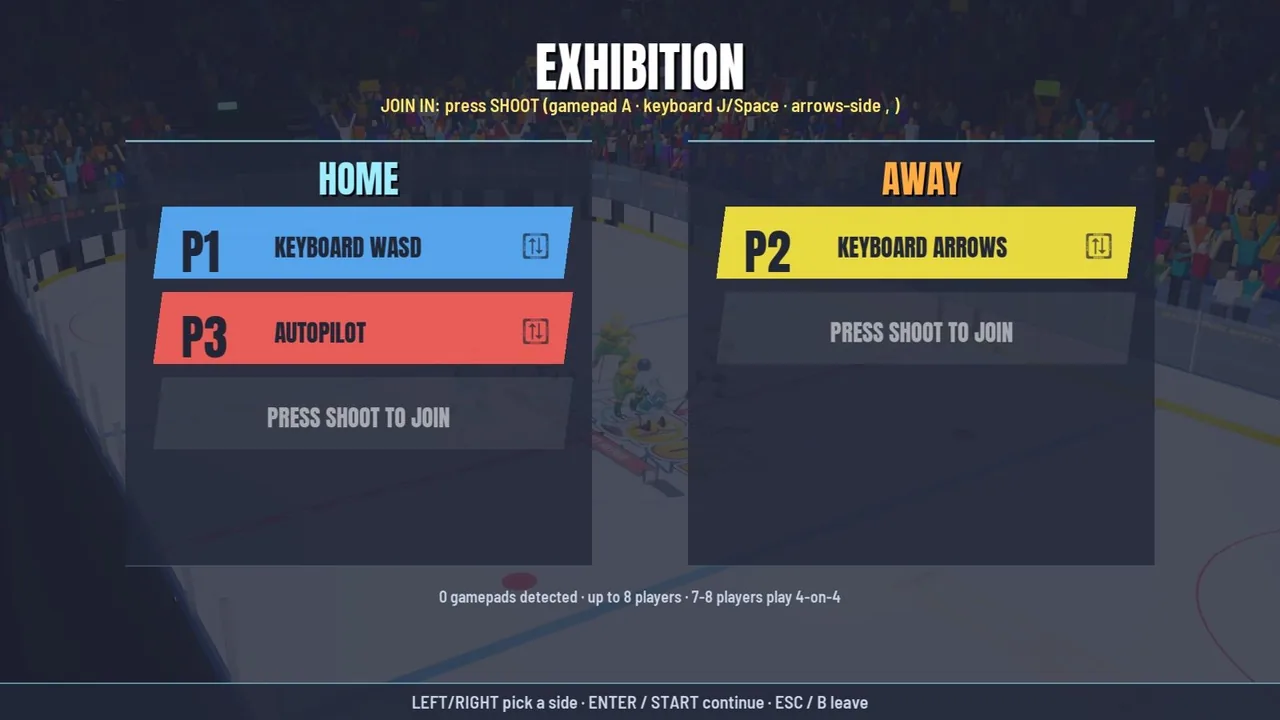
Two players can share the keyboard, one on W A S D with J, K, L, I and U, and the other on the arrow keys with comma, period, slash, semicolon and apostrophe or the number pad, and gamepads join in any mix, up to eight humans. On the join screen, everyone presses Shoot to join and picks a side, and the computer fills the rest of each team. Exhibition takes one to eight players. Tournament is an arcade ladder for up to four against the seven other teams, easiest first, where a loss means a rematch and beating them all brings a champions’ celebration with 60 hats. Practice puts one skater against a goalie and resets the puck at a new spot after every attempt. Behind the title screen and the menus, the computer plays a game of its own, like a cabinet’s attract mode.
The computer’s skaters, goalies and fighters make every decision through the same intent structure as a human’s pad, with support positions, open passing lanes and shot quality, and they scale over five difficulties, from Very Easy to Very Hard. Catch-up, which can be turned off, gives a team that trails by two or more goals slightly faster skaters and better odds on both ends of a shot. There are six cameras, Broadcast, High Broadcast, Overhead, End Zone, Close Action and Blimp, and four codes typed on the menus: BIGHEAD, TINY, ALLSTAR, which unlocks the Riot All-Stars and the Pixel Pushers, and FRENZY, which makes checks build anger three times as fast and lets fights come 8 seconds apart instead of 40.
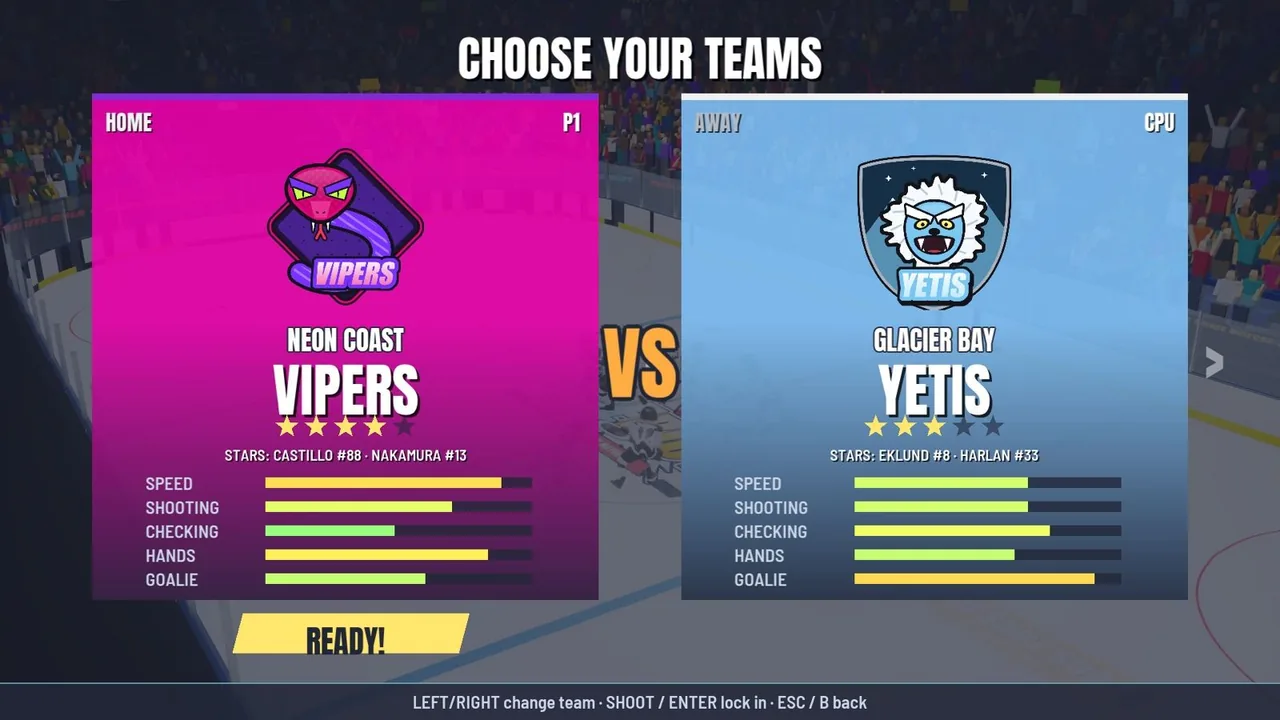
The eight teams are the Northport Narwhals, the Brimstone Inferno, the Glacier Bay Yetis, the Steel Valley Hammers, the Bayou Brawlers, the Neon Coast Vipers, the Timber Ridge Grizzlies and the Rocket City Comets. Each has six skaters and a goalie, with ratings from 1 to 10.
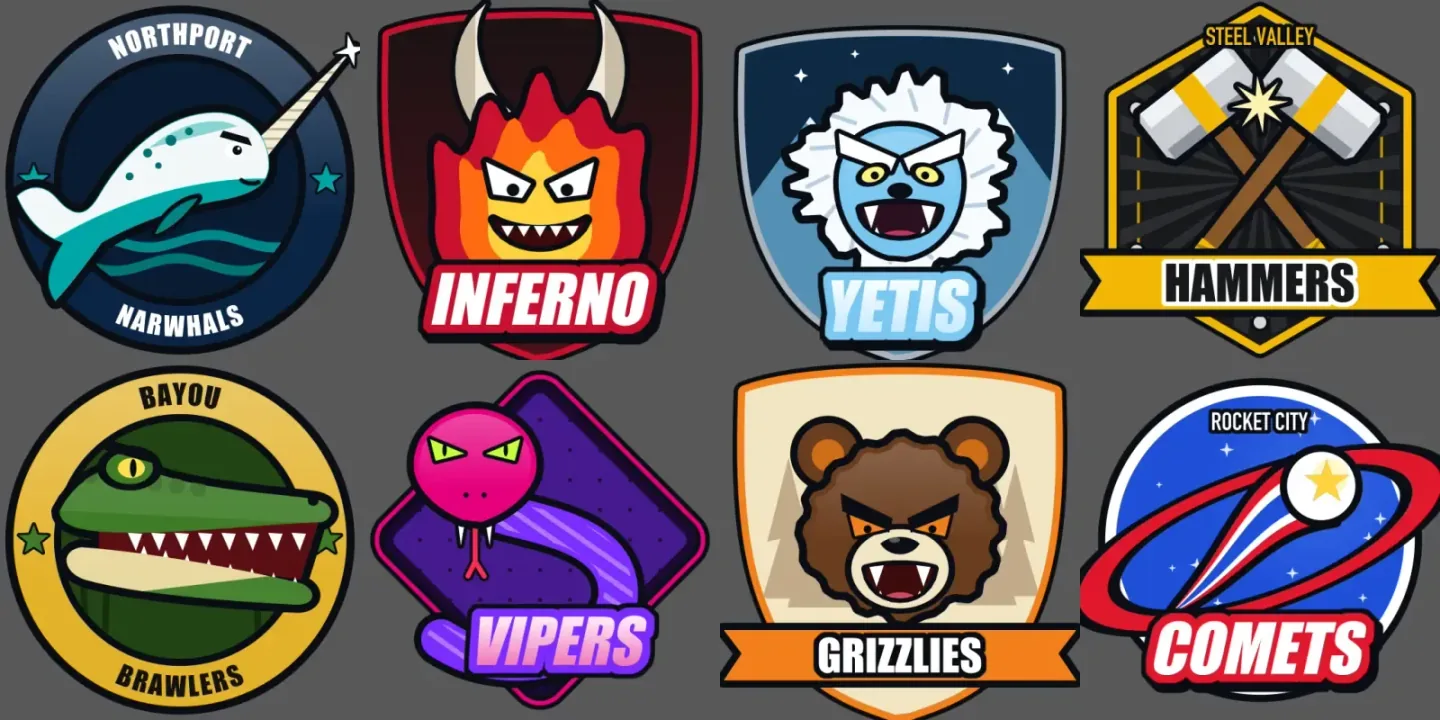
gen_branding.py.Built from code
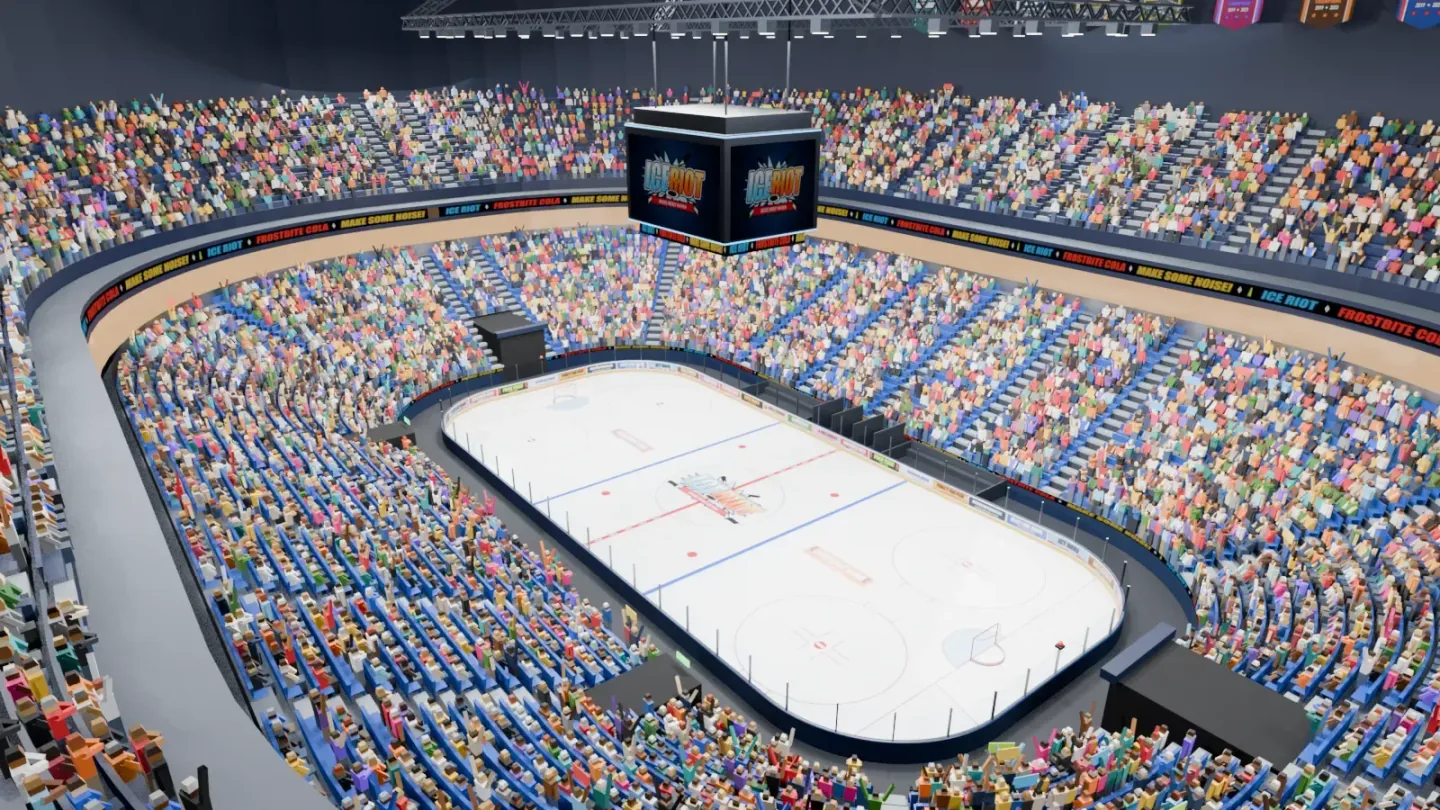
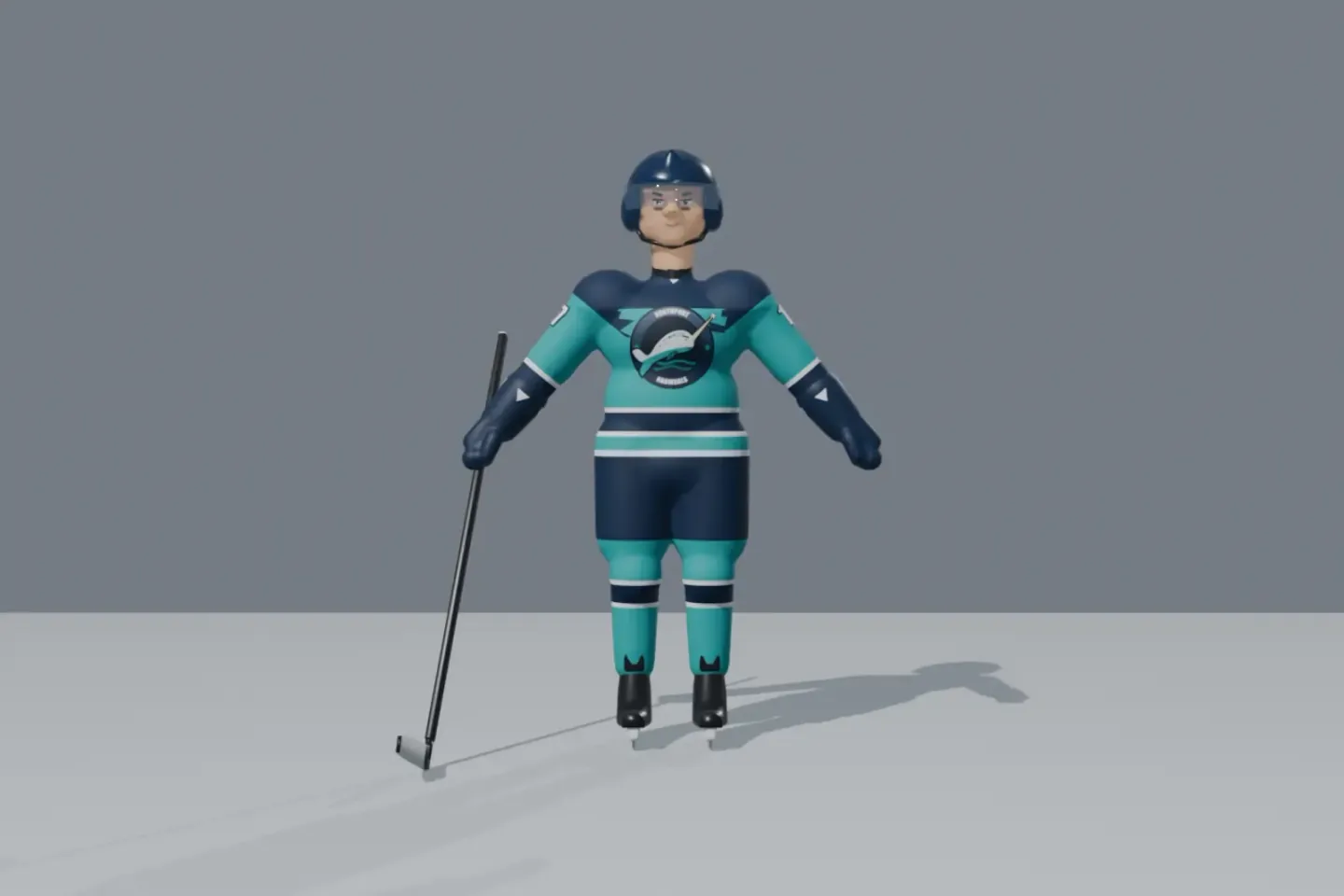
Blender/gen_character.py builds the skater and the goalie on one shared skeleton, along with the helmet, glove and stick that fly off in hits and fights. gen_anims.py authors all 48 animation clips as keyed pose parameters, solved with inverse kinematics on every frame. gen_rink.py makes the ice markings, the boards and glass, the nets, the goal light and the puck, and gen_arena.py makes the seating bowl, suites, benches, penalty boxes, banners, the center-hung jumbotron and a crowd of about 8,200 fans in one mesh that bob harder as the crowd gets excited. gen_branding.py draws the crests, the rafter banners, the logo and 16 fictional sponsor ads, and gen_props.py makes the hat-trick hats, the ambulance, an ice resurfacer that laps the rink between periods and the 3D title logo.
Tools/gen_audio.py makes all 173 sounds. It synthesizes 105 of them with NumPy: 77 effects, 14 crowd beds, reactions and organ stingers, 9 menu sounds and five music tracks, built from Karplus-Strong guitars and bass, an FM electric piano, a drawbar organ through a rotary speaker and a synthesized rock kit. The other 68 are announcer lines, spoken by macOS’s say command with the Daniel voice, converted with afconvert and run through a simulated PA chain. The seeds are fixed, so a rerun reproduces the same files, apart from the announcer, which depends on the installed voice.
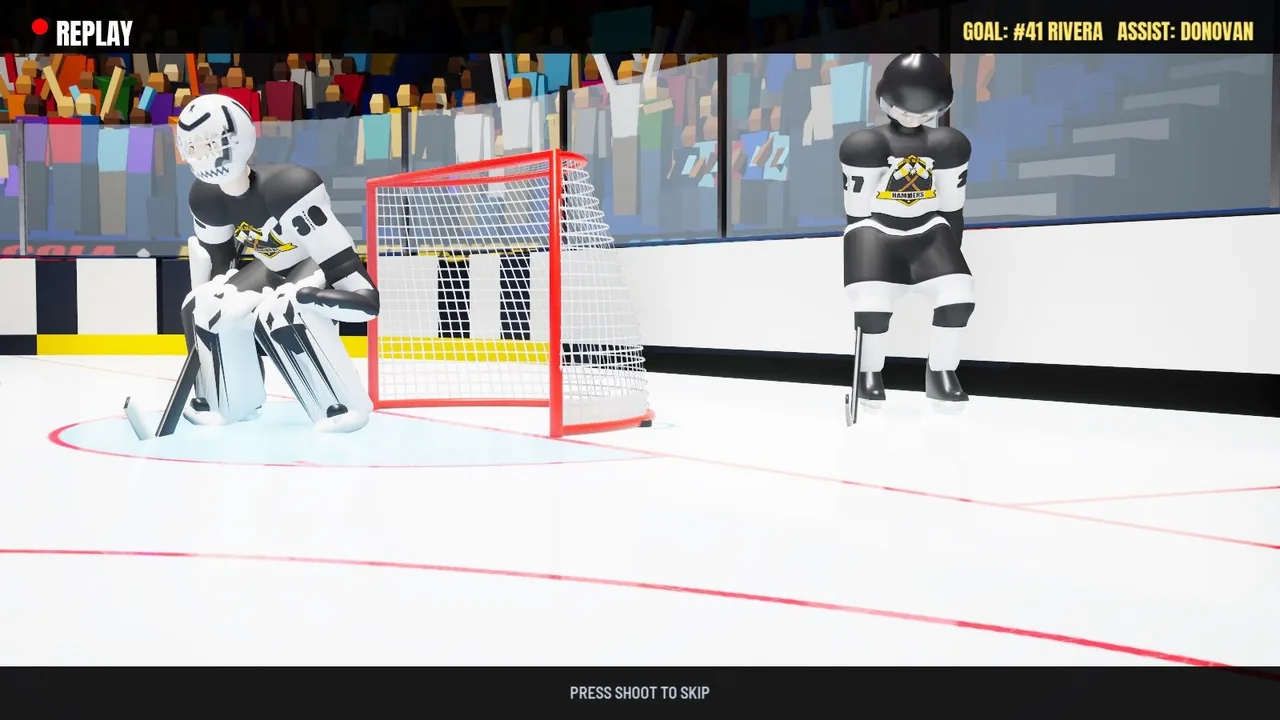
The game itself is 9,956 lines of C++ in 34 files in Source/IceRiot: the skating and puck physics, the rules, the AI, the six cameras, the replay buffer, which keeps seven seconds at 30 frames a second and plays a goal back at about half speed, and a HUD and menus drawn on Unreal’s canvas.
The browser version
The Play button opens the same C++ game, built by Tools/package.sh web for Unreal’s Wasm platform with Emscripten 6.0.10. The Pages workflow takes the browser build from a release’s IceRiot-Web.zip and deploys it next to the website. It needs WebGPU, so it runs in desktop Chrome and Edge or Safari 26 and later, and in a browser without WebGPU, the website’s Play buttons open a notice with the Mac download and a Try anyway link. In the capture for this page, the loader timed a few test draws, picked Unreal’s mobile deferred renderer on WebGPU and ran the engine with worker threads, and the page reloads itself once under a service worker to get the isolation that threads need. A first visit downloads about 94 MB, or 193 MB uncompressed, most of it a 133 MB WebAssembly binary and 59 MB of cooked game content.
How it was made
The repository has 18 commits, made in under three hours. The first holds a README stub and the icon, and the other 17, which add the game, the rules, the art pipeline, the website, the trailer and the packaging and release scripts, are all co-authored by Claude. The README and the website say every model, texture, animation and sound comes from scripts. The README calls the teams, players, logos, sponsors and announcer lines fictional, and the website calls them original works made for the project.
Play it
Play in your browser, or start from the website, which has the features, modes, teams and controls. Press Enter on the title screen, pick Exhibition, press Shoot to join, then Enter to choose teams. Player one skates with W A S D, shoots or checks with J or Space, passes or pokes with K, turbos with L or Left Shift, switches or dekes with I, hooks or drops a pass with U, changes the camera with C and pauses with Esc. Player two uses the arrow keys with comma, period, slash, semicolon and apostrophe, or Numpad 1 to 5.
Download the Mac app from the latest release. It’s signed ad hoc, not notarized, so the first launch needs Open Anyway in System Settings, under Privacy & Security. Building it takes macOS with Xcode, a source build of Unreal Engine 5.9 at ~/UnrealEngine, Blender 5.3 and Git LFS, and the web build also needs Emscripten 6.0.10. The scripts in Tools regenerate the art and audio, import them, compile the game and package IceRiot.app or the browser build.
Browse the source on GitHub. The creation date shown here is the GitHub repository’s UTC creation date. The cover and the power shot, replay, fight, title, join and team selection pictures are the website’s screenshots of the desktop game, the arena and skater pictures are the website’s Blender renders, and the crest sheet is the website’s copy of the preview that gen_branding.py draws. All of them were shrunk with Lanczos resampling. The browser fight and replay were captured for this page from the live browser version in headless Chromium on Linux with an AMD Radeon 8060S, with the game’s -irwatch switch passed through the page’s window.ueExtraArgs hook so that the computer played both sides. The trailer and its poster are the website’s own, and the code excerpt is from IRGameplay.cpp.