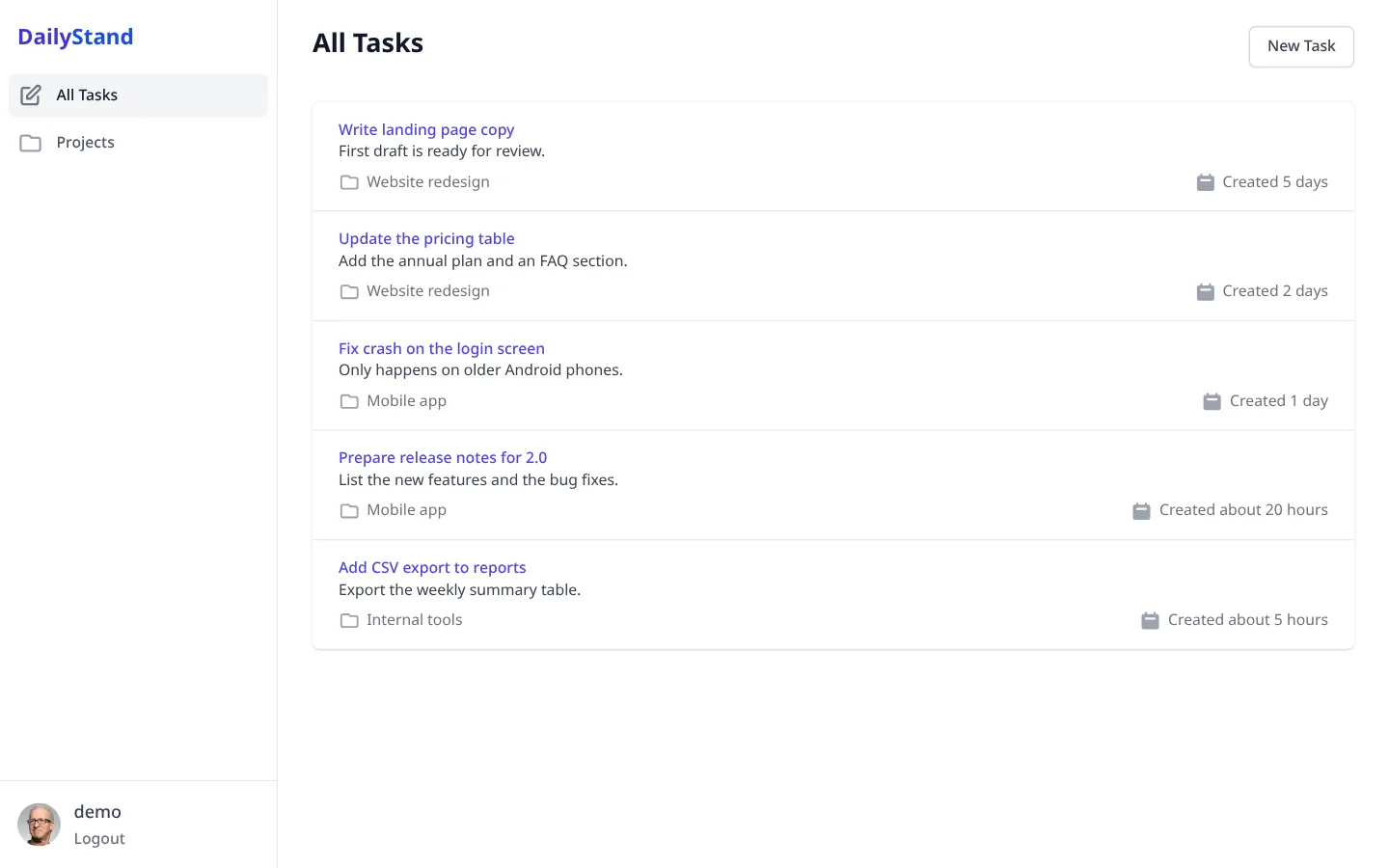
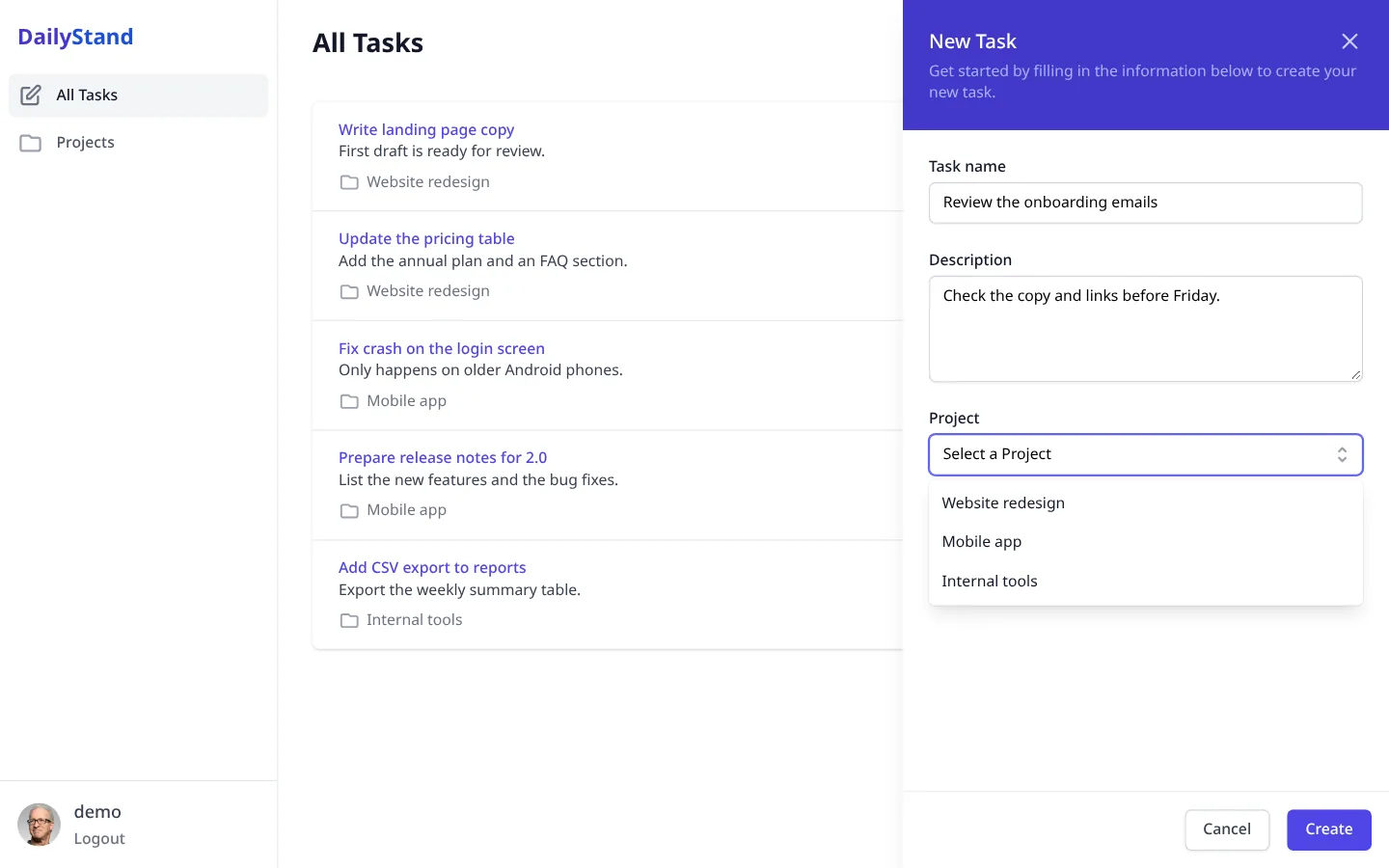
DailyStand is a small web app for keeping a list of tasks, grouped by project. You register with an email and password, add projects, and add tasks to them from a panel that slides in from the right. It’s split across two repositories: dailystand-client, a React app built with Vite, and dailystand-server, a Rails API that answers GraphQL queries.
The client was written in 16 commits between January 27 and February 5, 2021, and the server was pushed in a single commit on February 4. Neither has changed since. The name came back in 2026 for dailystand.dev, an async standup platform, which is a separate codebase on a different stack.
What it does
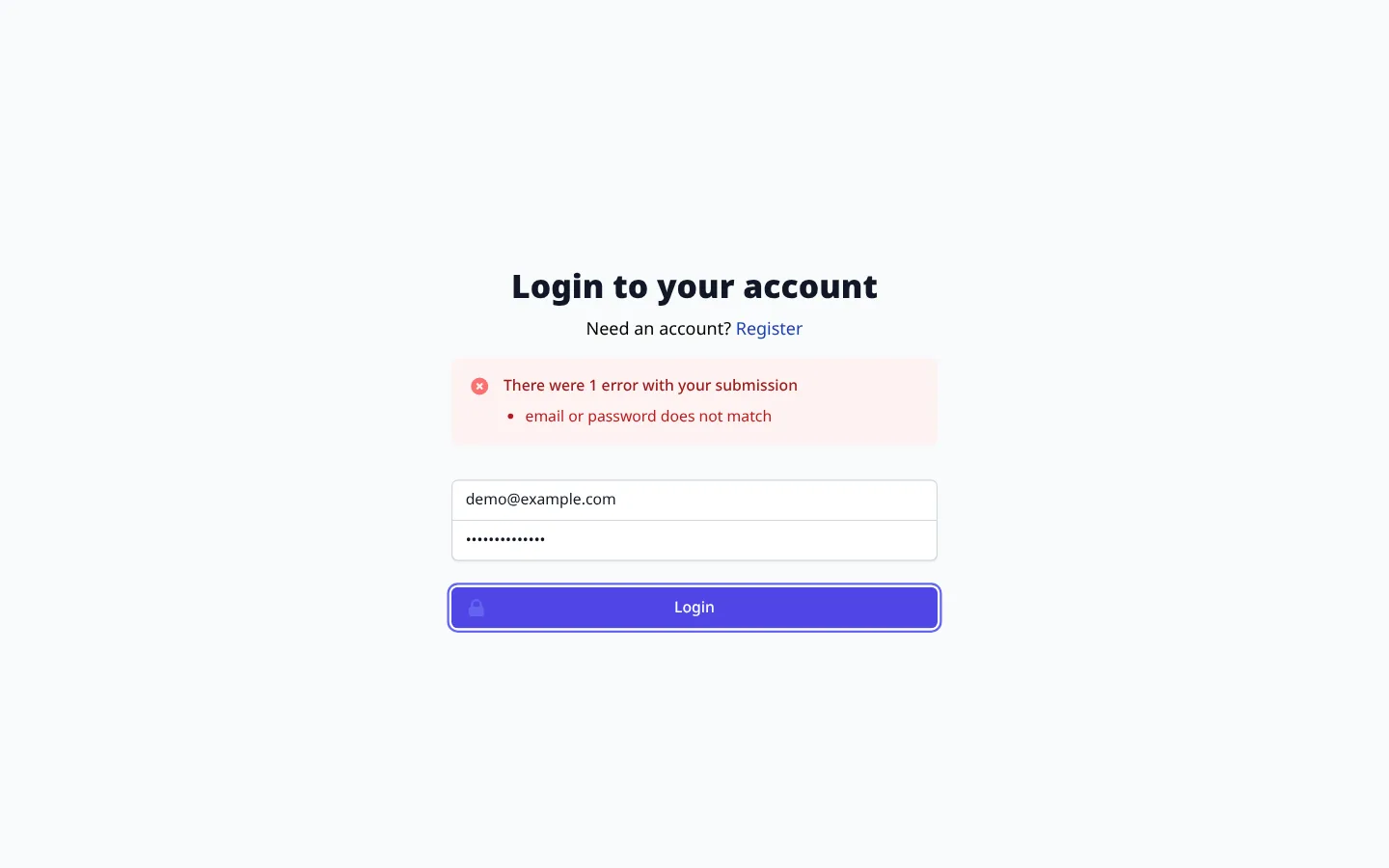
- Accounts. Register and log in with an email and password. The server checks the password with bcrypt and returns a JSON Web Token that lasts 12 hours. The client keeps the token in
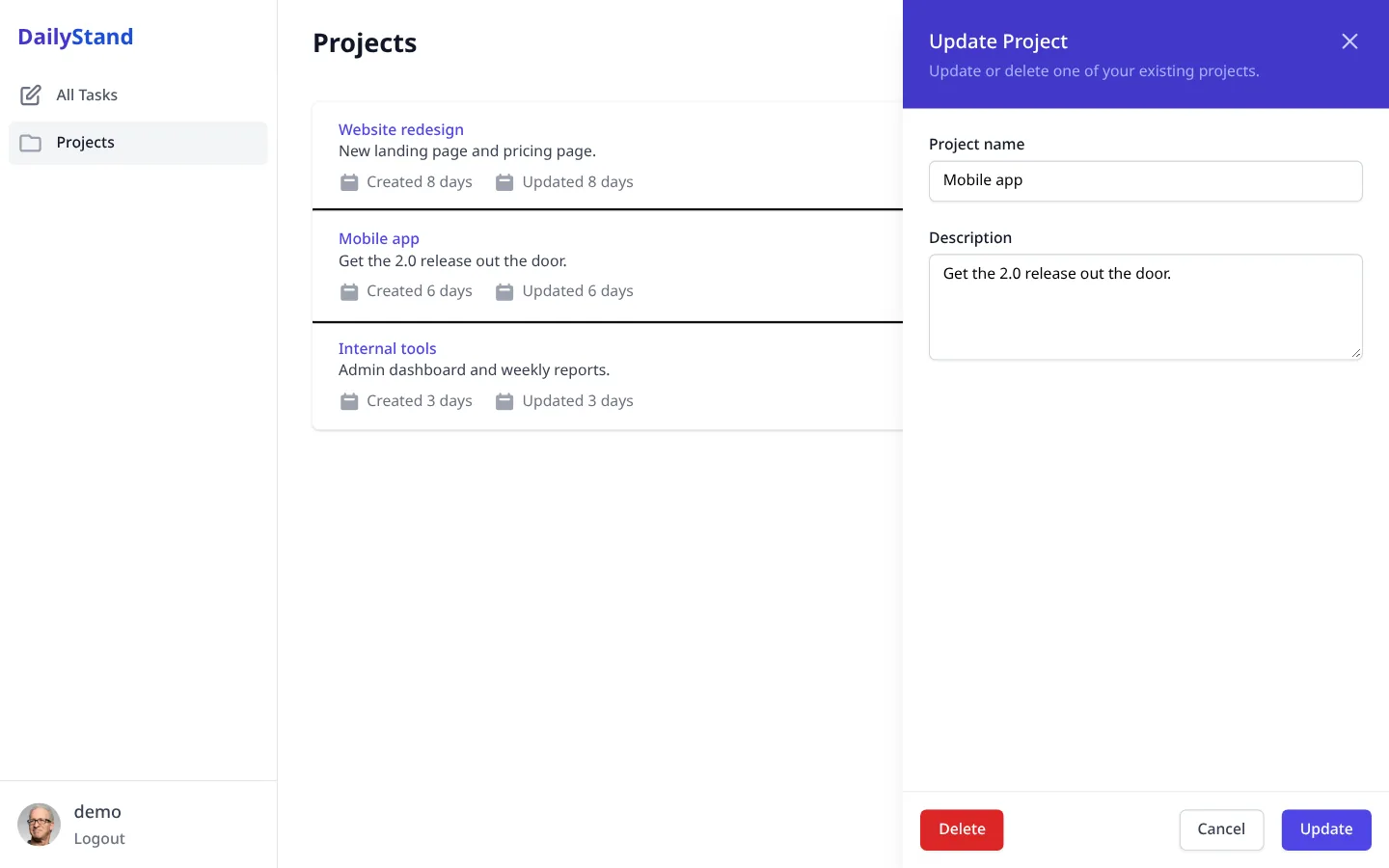
localStorageand sends it as a bearer token with every request. Errors come back as a list of fields and messages, and the form lists them above the inputs. - Tasks. All Tasks lists every task with its description, its project and how long ago it was created. New Task opens a form with a name, a description and a project picker. Clicking a task opens the same form to update or delete it.
- Projects. The Projects page works the same way, with a name and a description for each project.
On narrow screens, the sidebar moves behind a menu button. There’s no standup screen yet. The server also models subtasks, with their own queries and mutations, and a completion time on tasks and subtasks, but the client doesn’t use either.
How it’s built
The client was built on a beta of Vite 2.0 (2.0.0-beta.51 in the lockfile), with React 17 and React Router 5, and each page loads lazily. Apollo Client 3.3 talks to the API, and a few small helpers write each created, updated or deleted record straight into Apollo’s cache instead of fetching the list again. Forms use Formik with Yup validation. Styling is Tailwind CSS 2 with its forms plugin, Headless UI runs the panel and menu transitions, and date-fns writes the “Created 2 days” labels.
The server is an API-only Rails 6.0 app with a single route, POST /graphql. GraphQL Ruby 1.12 defines the schema, with Relay-style connections for lists and mutations that each take one input object, and graphql-batch loaders fetch related users, projects and tasks in batches. Records live in PostgreSQL, passwords use has_secure_password, tokens are signed with the jwt gem, and rack-cors lets the client call the API from another origin.

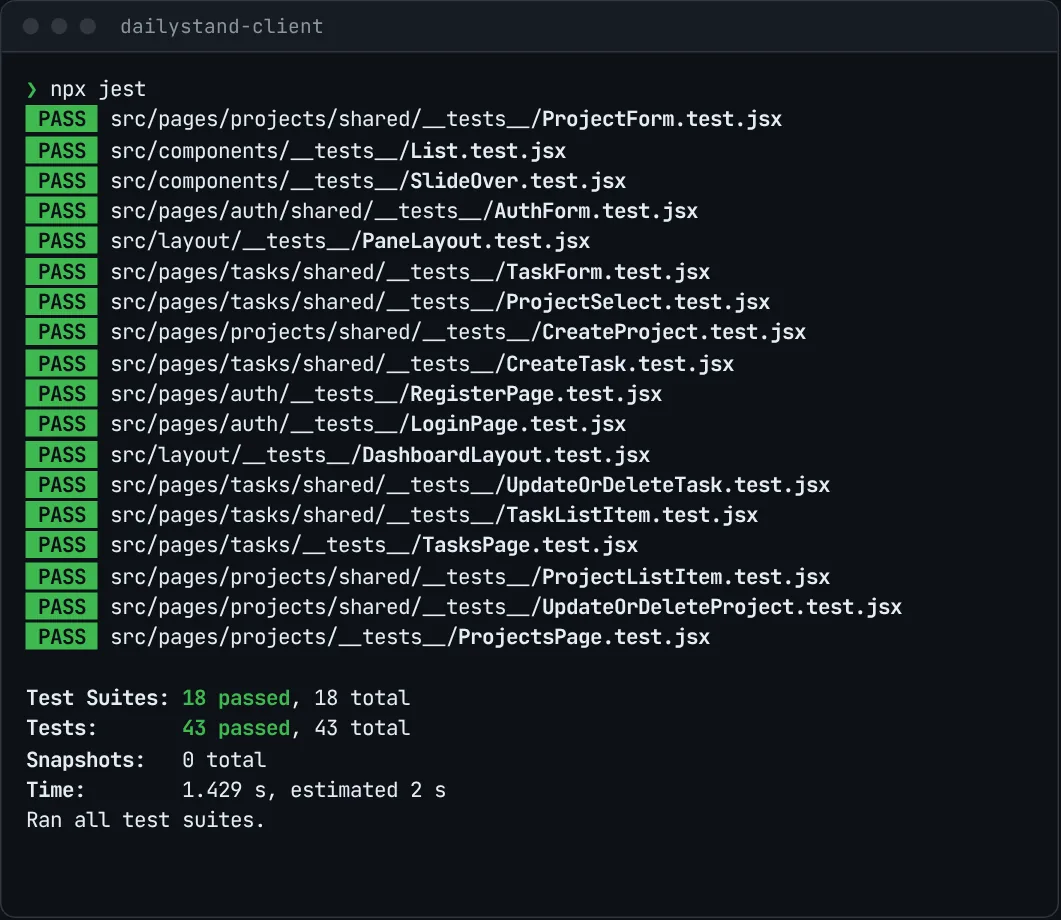
The client has 18 test files with 43 tests, written with Jest and React Testing Library. Twelve of them render components inside Apollo’s MockedProvider, so they need no server. They all still pass.
Running it today
The client still installs from its lockfile and runs with Node 14: npm install, then npm run dev. It expects the API at http://localhost:3000/graphql, which is set in its .env file. The server’s README covers bundle install, rails db:create, rails db:migrate and rails s, which need Ruby 2.6.3 and PostgreSQL, and the server also reads a JWT_SECRET environment variable.
Ruby wasn’t available for the screenshots on this page, so the client ran against a stand-in: a small Node.js GraphQL server written from the Rails app’s schema and resolvers, holding sample data in memory.
The creation date shown here is the GitHub repository’s UTC creation date. The screenshots come from running the client locally against that stand-in with sample data, the code card shows a real file from the server, and the test run is real terminal output.